
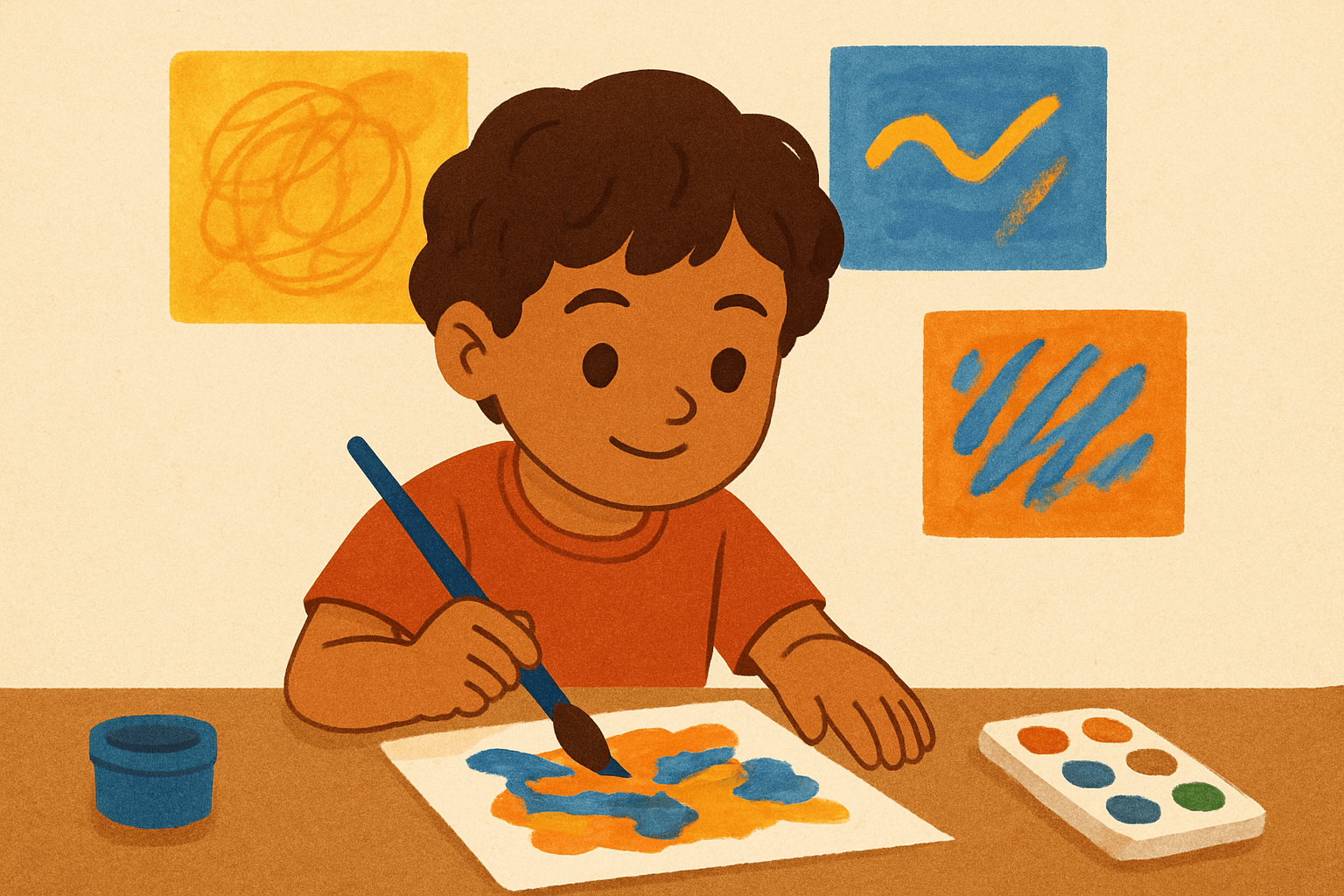
When your child proudly holds up a crayon drawing of a purple cow or a rainbow-colored rocket, it’s tempting to say, “Cows aren’t purple,” or “That rocket looks funny.”
But what if those moments of creative chaos were actually building the same kind of brain power your child will need to succeed in science, technology, engineering, and math (STEM)?
Welcome to the world of process-oriented art — where the goal isn’t perfection, but exploration.
And here’s the secret: this open-ended creativity doesn’t just nurture imagination; it trains the exact thinking skills that power innovation, problem-solving, and discovery in STEM fields.
Let’s explore why letting your child mess up beautifully may be the smartest thing you can do for their future.
1. The Pressure to “Draw Right” — and Why It’s a Problem
Many parents and teachers fall into a familiar trap: focusing on product over process.
We praise neatness, symmetry, or accuracy (“That’s a good tree!”) instead of curiosity, experimentation, and risk-taking (“Tell me how you made that pattern!”).
When we correct a child’s drawing, we send a subtle message:
“Art has rules — and there’s a right answer.”
But real creativity — the kind that drives scientists and engineers — comes from asking:
“What if I tried this another way?”
Children who are constantly corrected start to fear mistakes.
They begin drawing — and thinking — within boundaries.
And that mindset quietly limits their capacity for STEM problem-solving, which thrives on failure, testing, and iteration.
2. What Is Process-Oriented Art?
Process-oriented art is exactly what it sounds like: art focused on the process of making, not the end product.
It’s about:
- Experimenting with materials (What happens if I mix salt with paint?)
- Exploring textures, shapes, and patterns
- Observing cause and effect
- Learning through trial and error
There’s no template, no expected outcome, and no wrong answers — just the joy of discovery.
The final result may look messy, but beneath that mess lies deep cognitive development.
3. How Process Art Builds STEM Brains
Here’s what scientists have discovered: the mental habits children use when exploring art are the same ones they use in science and engineering.
a. Observation
In art: noticing color, light, and form.
In science: observing patterns and details in experiments.
b. Hypothesis and Testing
In art: “What happens if I press harder?” or “If I mix red and blue, what color appears?”
In STEM: forming and testing predictions through experimentation.
c. Problem Solving
In art: figuring out how to fix a torn paper or make a texture stand out.
In engineering: troubleshooting design flaws or system failures.
d. Flexibility and Adaptability
Art teaches that mistakes can lead to new ideas — a crucial mindset in innovation.
So when your child paints their sky green or invents a spaceship made of feathers, they’re not “wrong” — they’re practicing complex, flexible thinking.
4. The Neuroscience of Creativity and STEM
Modern neuroscience reveals that creative and analytical thinking use interconnected brain networks — particularly those involving the prefrontal cortex (planning), parietal lobes (spatial reasoning), and limbic system (emotion and motivation).
When a child engages in open-ended art:
- Their left and right hemispheres communicate more effectively.
- Dopamine levels increase, promoting curiosity and motivation.
- The brain’s executive functions — like focus, working memory, and flexibility — are strengthened.
These same brain circuits are essential for STEM learning, especially in engineering design, coding, and scientific reasoning.
In essence: art primes the brain for STEM.
5. Perfectionism: The Silent Creativity Killer
Children naturally love to explore. But as they grow, they often internalize a dangerous belief — that success means getting it “right.”
This mindset leads to perfection paralysis:
- They hesitate to draw unless they’re sure it’ll look good.
- They avoid challenges where failure feels visible.
- They stick to formulas instead of experimenting.
In STEM, failure is part of the process.
Engineers fail thousands of times before a design works. Scientists spend years testing hypotheses that don’t pan out.
By embracing process art, you’re helping your child fail joyfully — and try again with confidence.
6. Process vs. Product: The Classroom Example
Let’s compare two classrooms.
Classroom A (Product-Oriented)
The teacher hands out identical worksheets: “Draw a butterfly.”
All students copy the same shape. The goal: accuracy.
Classroom B (Process-Oriented)
The teacher provides paints, papers, and paper scraps.
The challenge: “What could you make that flies?”
Some make butterflies, others create rockets, birds, or imaginary creatures.
The goal: exploration.
In Classroom B, students develop:
- Divergent thinking
- Design flexibility
- Confidence in their own ideas
These are the same skills that make innovators and inventors thrive.
7. Art as Early Engineering
Think of process art as pre-engineering play.
When a child:
- Builds with clay
- Constructs with cardboard
- Mixes colors or materials
- Reinvents tools for fun
They’re not just “doing crafts.”
They’re testing structures, learning balance, and discovering cause and effect — all foundational STEM skills.
Every crayon drawing, glue experiment, and tape sculpture is a mini engineering lab in disguise.
8. How Process Art Strengthens STEM Habits of Mind
The National Science Foundation identifies eight key “Habits of Mind” for STEM learners.
Process art naturally cultivates all eight:
| STEM Habit | How Process Art Builds It |
|---|---|
| Curiosity | “What if I mix these colors?” |
| Creativity | Combining materials in new ways |
| Collaboration | Sharing space, tools, and ideas |
| Persistence | Rebuilding after a failed attempt |
| Flexibility | Adapting plans mid-project |
| Communication | Explaining creative choices |
| Critical Thinking | Evaluating what worked or didn’t |
| Reflection | Looking back to improve next time |
In other words, every time a child makes art freely, they’re rehearsing for a STEM challenge.
9. The Parent’s Role: Let Go and Observe
As parents, we often want to help — but true process art means stepping back.
Here’s how to guide without taking over:
- Ask, don’t direct.
Try: “What are you noticing?” or “What happens if you try this?”
Avoid: “No, that’s not how you do it.” - Value process language.
Say: “I see you’re layering the colors,” instead of “That’s pretty.” - Encourage reflection.
Ask: “What did you like most about making this?” or “What surprised you?”
Your curiosity models curiosity.
Your restraint gives permission for experimentation.
10. Practical Process Art Ideas for Home
Here are simple, mess-friendly art activities that promote STEM thinking:
1. Color Chemistry
Mix food coloring, vinegar, and baking soda. Watch reactions and color changes.
Ask: “Why do you think the bubbles appear?”
2. Structure Challenge
Provide straws, tape, and paper. Challenge: build the tallest tower that stands.
3. Texture Hunt Collage
Collect leaves, fabrics, and found materials. Create patterns by texture type.
4. Shadow Tracing
Shine a flashlight on toys and trace their shadows. Discuss light direction.
5. Ice Painting
Freeze water with a drop of paint inside. As it melts, mix and observe color diffusion.
These activities teach observation, cause-effect, and problem-solving — through play.
11. Teachers: Integrating Art into STEM (STEAM)
Forward-thinking schools are adding the A for Art into STEM, creating STEAM.
Why? Because innovation doesn’t happen in a vacuum — it happens when creativity meets logic.
Examples:
- Art + Math → Symmetry drawings, pattern tessellations
- Art + Engineering → Paper bridges, recycled-material sculptures
- Art + Technology → Digital drawing, animation, 3D design
- Art + Science → Nature sketching, color-mixing experiments
Integrating art reawakens curiosity and makes abstract STEM ideas tangible.
12. The Emotional Side: Building Resilience Through Art
Art provides a safe space for emotional experimentation.
Children learn:
- To tolerate uncertainty
- To manage frustration
- To persist despite setbacks
Those emotional skills — patience, curiosity, adaptability — are the foundation of STEM perseverance.
Because breakthroughs don’t come from knowing the right answer; they come from staying curious when things don’t work.
13. The Science of Flow: Deep Focus in Art and STEM
Psychologists call it “flow” — the mental state of being fully absorbed in a task.
Children often enter flow when engaged in process art.
Flow develops:
- Focus control
- Intrinsic motivation
- Goal persistence
The same state occurs when coding, designing, or solving equations.
So, allowing unstructured art time actually strengthens a child’s ability to focus deeply — a core STEM competency.
14. When to Step In (and When Not To)
You might wonder: “Should I correct them ever?”
Here’s a rule of thumb:
- If the goal is expression or exploration → Don’t correct.
- If the goal is a specific skill (like drawing perspective) → Offer guidance after the creative process, not during.
Let discovery lead; refinement can follow later.
15. The Long-Term Payoff: Innovation and Originality
Children who grow up with freedom in art tend to:
- Take intellectual risks
- Handle ambiguity better
- Generate original solutions
Those are the same traits that drive great inventors, designers, and scientists.
From Da Vinci’s sketchbooks to NASA’s prototype labs — creativity and curiosity are inseparable.
16. The Takeaway: Art Is STEM’s Secret Partner
If we want the next generation of problem solvers, innovators, and thinkers, we must first let them play freely — with colors, textures, and ideas.
Every uncorrected doodle is a rehearsal for scientific discovery.
Every messy paint splatter is practice for resilience and innovation.
So next time your child proudly shows you their upside-down tree or orange ocean, smile and say:
“Tell me how you thought of that.”
Because that conversation — not the correction — is where real learning begins.
Final Thought
Let’s stop measuring creativity by how closely it mirrors reality.
Let’s measure it by how deeply it explores possibility.
In the messy, unpredictable process of making art, children are not just expressing imagination — they’re engineering their brains for the future of science and innovation.