
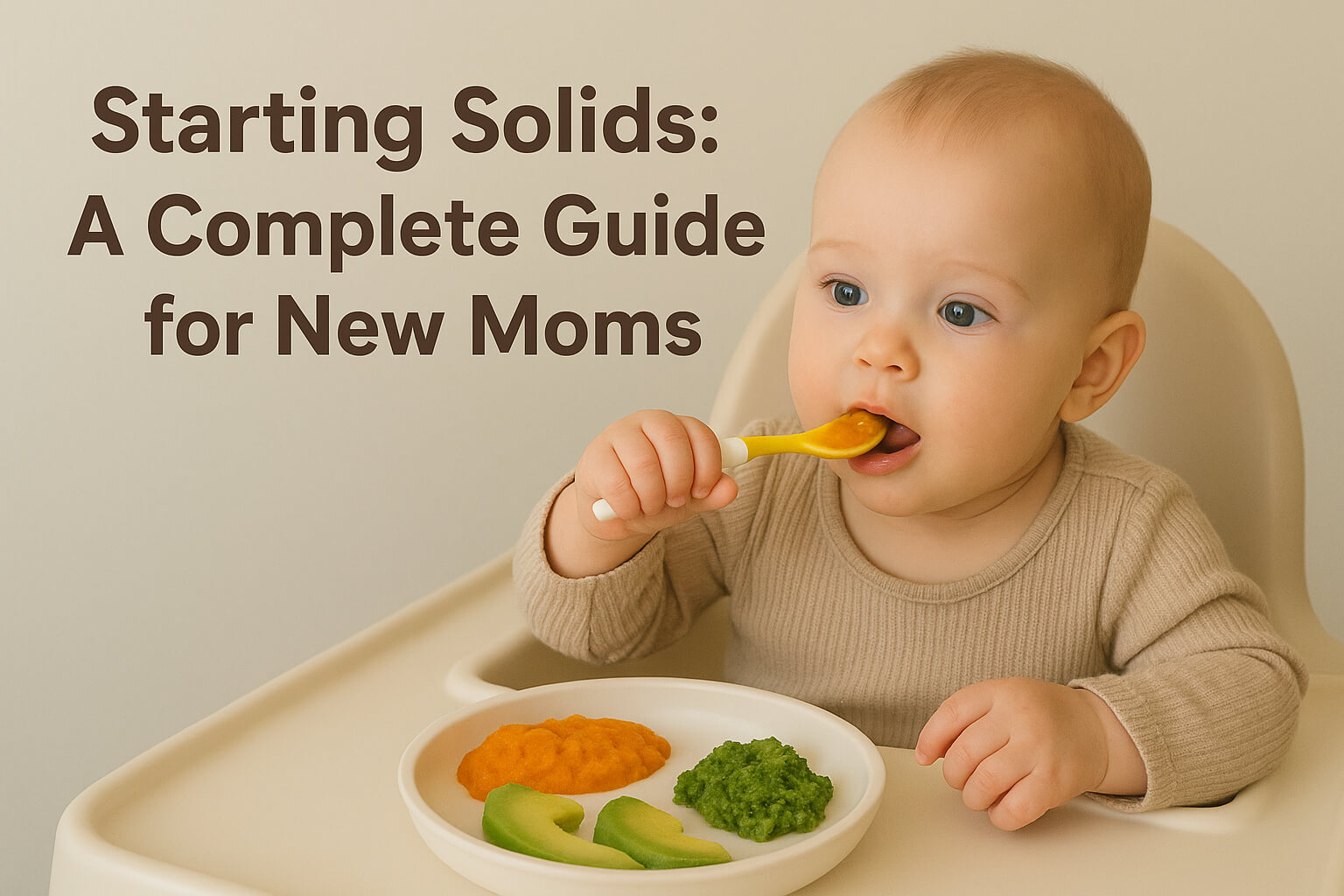
For new moms, this stage can be a beautiful mix of joy, curiosity, and a little confusion. When do you start? What should you give first? How do you know your baby is ready? What if they refuse to eat? What about allergies?
This detailed guide answers all your questions, removes the stress, and helps you enjoy the journey of introducing solids in a safe, confident, and healthy way.
Chapter 1: When Should You Start Solid Foods?
One of the most common questions new moms ask is: “When is the right time to start solids?”
Most pediatric guidelines—including WHO and AAP—recommend starting solid foods around 6 months of age. However, age alone is not enough. Babies need to show developmental signs that they are ready to explore food.
Signs Your Baby Is Ready for Solids
Your baby may be ready to start solids if they:
- Can sit up with minimal support
- Have strong head/neck control
- Show curiosity toward food—watching you eat, reaching for food
- No longer push food out with their tongue (reduced tongue-thrust reflex)
- Can open their mouth when food approaches
If your baby is 4–5 months and seems hungry, it’s still better to wait until the developmental signs appear. The digestive system needs time to mature, and starting too early may lead to tummy discomfort or nutrient imbalance.
Always consult your pediatrician before starting solids, especially if your baby was born early or has allergy concerns.
Chapter 2: What Does “Solid Food” Actually Mean?
When people hear “solids,” they imagine chunks of food—but that’s not what babies start with.
Solids at 6 months means:
- Purees
- Soft mashed foods
- Soft finger foods (if baby-led weaning)
- Blended or smooth textures
Remember, at this stage, solid foods are for exploration, not nutrition. Breast milk or formula still provides 90% of nutrition for the first 12 months.
Solids help babies:
- Practice chewing
- Improve motor skills
- Explore flavors and textures
- Discover self-feeding
Think of this phase as “food discovery,” not “full meals.”
Chapter 3: What Foods Should You Start With?
There is no single “first food” that’s right for every baby, but nutritionists recommend starting with iron-rich foods since babies’ iron stores begin to drop at 6 months.
Here are excellent first foods:
Iron-Rich Options
- Iron-fortified baby cereal
- Pureed lentils
- Pureed beef, chicken, or lamb
- Mashed beans
- Pureed spinach
Common Beginner Purees
- Sweet potatoes
- Avocado
- Banana
- Apple
- Carrots
- Pear
- Pumpkin
Healthy Fats for Brain Development
- Avocado
- Full-fat yogurt
- Olive oil
- Chia seeds (soaked)
- Peanut butter (thinned)
Protein Options
- Eggs
- Fish (boneless)
- Chicken
- Tofu
- Greek yogurt
Don’t worry—you don’t need fancy ingredients. Simple, whole foods work best.
Chapter 4: How to Prepare the First Foods Safely
Purees for Beginners
Start with very smooth purees:
- Steam or boil food
- Blend with water, breast milk, or formula
- Ensure there are no lumps
As your baby grows:
- 7–8 months → thicker purees
- 9–10 months → mashed foods
- 10–12 months → soft finger foods
Baby-Led Weaning (BLW)
Some parents choose BLW, letting babies feed themselves soft finger foods.
Examples:
- Soft avocado slices
- Steamed carrot sticks
- Soft banana pieces
- Very tender sweet potato wedges
Important: BLW foods must be soft enough to mash with two fingers.
Chapter 5: Foods to Avoid in the First Year
Not all foods are safe for babies under one year old.
Never give these before age 1:
- Honey (can cause botulism)
- Cow’s milk as a drink (okay in recipes or yogurt form)
- Unpasteurized milk products
- Whole nuts (choking hazard)
- Popcorn
- Hard candy, gum
Foods to be careful with:
- Salt (babies’ kidneys can’t handle it)
- Sugar (creates unhealthy habits early)
- Excessive citrus (may irritate tummy)
- Raw eggs or raw fish
If unsure about a food, ask a pediatrician.
Chapter 6: The 3-Day Rule for Introducing New Foods
To keep your baby safe from allergies, use the 3-day rule:
- Introduce ONE new food at a time
- Wait 3 days before adding another
- Observe for any reactions
Possible allergic reactions include:
- Rash
- Hives
- Vomiting
- Diarrhea
- Swelling of eyes/lips
- Persistent coughing
- Breathing difficulty (seek emergency care)
Although allergies can be scary, remember that most babies tolerate foods well. And introducing allergens early (like eggs or peanuts) may reduce allergy risks.
Chapter 7: Sample First Month Meal Plan
Here is a gentle 4-week introduction plan for new moms:
Week 1 (Single Foods)
- Day 1–3: Sweet potato
- Day 4–6: Avocado
- Day 7–9: Banana
Week 2 (Vegetables & Iron Foods)
- Day 10–12: Carrot puree
- Day 13–15: Lentil puree
- Day 16–18: Apple puree
Week 3 (Proteins & New Textures)
- Day 19–21: Egg yolk puree
- Day 22–24: Chicken puree
- Day 25–27: Multi-veggie blend
Week 4 (Mixing Foods)
- Day 28–30: Yogurt + fruit
- Banana + oatmeal
- Sweet potato + chicken
This is just a sample—you can adjust based on your baby’s tolerance and pediatrician’s guidance.
Chapter 8: How Much Should Your Baby Eat?
Many new moms worry about whether their baby is eating enough. Here’s the truth:
Babies don’t need much at first.
Start with:
- 1–2 teaspoons
- Gradually increase to 2–4 tablespoons
- As months pass, offer 2–3 meals a day
Your baby will naturally eat more as they grow. Follow their cues instead of forcing bites.
Signs your baby is full:
- Turns head away
- Pushes spoon away
- Gets fussy
- Closes mouth
- Throws food
Signs your baby is still hungry:
- Opens mouth for more
- Reaches for food
- Leans forward
- Gets excited when they see food
Trust your baby—they know their own hunger better than anyone.
Chapter 9: Balancing Breast Milk/Formula With Solids
Even after starting solids:
Breast milk or formula remains the main nutrition until age 1.
Solids complement milk—they don’t replace it.
Suggested feeding pattern for a 6–9 month-old:
- Milk feeding when baby wakes
- Solid meal mid-morning
- Milk feed in afternoon
- Solid meal in evening
- Milk feed before bed
This keeps your baby full, nourished, and well-balanced.
Chapter 10: Common Challenges New Moms Face
Starting solids isn’t always smooth. Here are the most common issues:
1. Baby refuses to eat
Normal! Babies need time to adjust. Keep offering without pressure.
2. Baby gags
Gagging is a natural safety reflex—not choking.
3. Baby spits food out
This means the tongue-thrust reflex is still fading.
4. Baby only wants breast milk
This is common at first. Continue offering solids gently.
5. Baby makes a mess
Mess = learning. Encourage self-feeding.
6. Concerns about choking
Always supervise and serve age-appropriate textures.
7. Allergies
Introduce allergens slowly and watch carefully.
Remember: You’re doing great. All babies learn at their own pace.
Chapter 11: Creating a Positive Feeding Environment
Feeding time should be calm, enjoyable, and pressure-free.
Here’s how to make it beautiful:
1. Use a high chair
Keeps baby upright and safe.
2. Eat together
Babies learn from watching you.
3. Avoid distractions
No TV, no phone—just the moment.
4. Let your baby explore
Touching, squishing, and smearing food builds sensory skills.
5. Celebrate small bites
Never force-feed. Gentle encouragement builds lifelong healthy habits.
Chapter 12: Frequently Asked Questions (FAQ)
1. Can I start solids at 4 months?
Not recommended unless your doctor specifically suggests it.
2. Can I give water?
A few sips after 6 months is fine.
3. Should I introduce fruits before vegetables?
Either is fine—fruits do not cause a “sweet tooth.”
4. How many meals per day at 6 months?
Start with 1, move to 2 meals by 8 months, and 3 by 10–12 months.
5. Is baby-led weaning safe?
Yes, if done correctly with soft, safe textures.
Final Thoughts: You’re Doing an Amazing Job
Starting solids is a journey—not a race. Some days your baby will eat enthusiastically, and some days they’ll turn their head. That’s all normal.