
Feeding a newborn often feels like a full-time job. Whether you’re using formula, pumped breast milk, or a combination of both, knowing how much, how often, and what a healthy feeding schedule looks like can remove so much stress from early parenthood. Every baby is unique, but understanding typical feeding patterns helps you respond confidently to your baby’s hunger cues and ensure they’re growing well.
This guide walks you through everything you need to know—feeding amounts by age, hunger and fullness signs, nighttime feedings, paced-bottle techniques, burping, common concerns, and sample schedules you can start using right away.
Why Bottle Feeding Can Feel Confusing for New Parents
Unlike breastfeeding, bottle feeding gives you clear measurements—but that doesn’t mean it’s easier. Parents often wonder:
- Is my baby eating enough?
- Is he drinking too fast?
- Should she be eating more at night or during the day?
- Why is he hungry again after just one hour?
- Is it normal for feeding amounts to change suddenly?
The good news: There are solid, evidence-based guidelines that help you understand what’s normal—and what’s not.
Let’s break it all down by age and need.
How Much Should a Newborn Eat? Feeding Amounts by Age
Remember, these numbers are general guidelines. Your baby may want a little more or less—and that’s perfectly okay.
0–2 Weeks: Tiny Tummies, Frequent Feeding
Average Amount per Feed: 0.5 – 2 ounces (15–60 ml)
Feeds per Day: 8–12
Total per 24 Hours: About 12–24 ounces
In the first days of life, newborn stomachs are very small—about the size of a marble. That’s why your baby needs lots of small, frequent feeds.
Key notes for this age:
- Feed every 2–3 hours, even if you have to wake them.
- Night feeds are essential—no skipping yet.
- Cluster feeding (several small feeds close together) is normal.
- Babies may take only 7–15 ml in the first 24 hours—don’t panic.
2–4 Weeks: Growing Appetite
Average Amount per Feed: 2 – 3 ounces (60–90 ml)
Feeds per Day: 8–10
Total per 24 Hours: 16–24 ounces
Around two weeks, babies begin settling into a more predictable rhythm. Their stomach size has grown to that of a ping-pong ball, so they can take more milk at once.
What you’ll notice:
- Longer stretches between feedings (sometimes 3 hours).
- Baby may sleep slightly longer at night—still feed on cue.
- Growth spurts around week 3 may temporarily increase hunger.
1–2 Months: More Milk, Fewer Feedings
Average Amount per Feed: 3 – 4 ounces (90–120 ml)
Feeds per Day: 7–9
Total per 24 Hours: 20–28 ounces
At this age, babies are more efficient eaters and can drink more at once.
Common patterns:
- Baby may go 3–4 hours between feeds.
- Night stretches may extend to 4–6 hours (if your pediatrician approves longer sleep).
- Appetite increases during the 6-week growth spurt.
2–4 Months: Steady, Predictable Feeding Routine
Average Amount per Feed: 4 – 5 ounces (120–150 ml)
Feeds per Day: 6–8
Total per 24 Hours: 24–32 ounces
Most babies settle into consistent patterns. Bottle feeding becomes easier, with more predictable hunger cues.
4–6 Months: Bigger Bottles, Stable Intake
Average Amount per Feed: 5 – 7 ounces (150–210 ml)
Feeds per Day: 4–6
Total per 24 Hours: 24–32 ounces
Around 4–6 months, milk intake peaks. Even though babies drink more per feeding, their total daily intake usually stays about the same because they feed less frequently.
Important: Solids generally begin around 6 months. Until then—milk only.
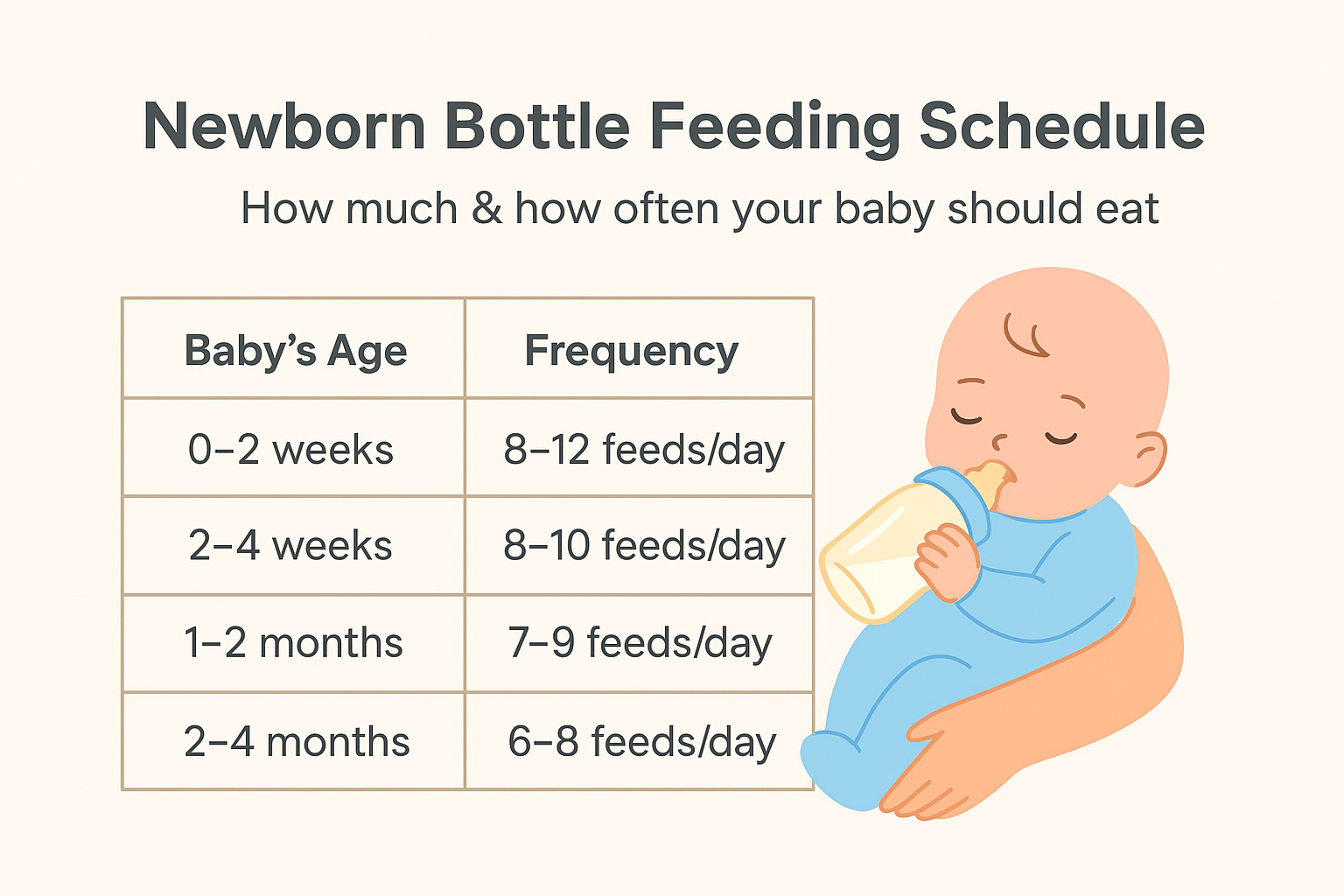
How Often Should You Bottle Feed a Newborn?
Here’s a quick overview:
| Baby’s Age | Frequency | Typical Gap Between Feeds |
|---|---|---|
| 0–2 weeks | 8–12 feeds/day | 2–3 hours |
| 2–4 weeks | 8–10 feeds/day | 2.5–3 hours |
| 1–2 months | 7–9 feeds/day | 3 hours |
| 2–4 months | 6–8 feeds/day | 3–4 hours |
| 4–6 months | 4–6 feeds/day | 4 hours |
The most important rule is simple: Feed your baby when they are hungry—not by the clock only.
Hunger Cues: When to Feed Your Baby
Babies rarely go from calm to screaming hunger without warning. Look for early signs to avoid stressful, frantic feeding sessions.
Early Hunger Cues
These are the best time to start feeding:
- Opening the mouth
- Lip smacking or licking
- Rooting (turning head toward touch)
- Putting hands to mouth
- Light fussing
- Rapid eye movements during sleep (active sleep)
Late Hunger Cues
If you reach this stage, feed immediately:
- Intense crying
- Stiff limbs
- Turning red
- Irritability or frantic movement
Feeding earlier makes the experience calmer for both parent and baby.
Fullness Cues: How to Know When Your Baby Is Done
Never force a baby to finish a bottle. Stop feeding when your baby shows:
- Slower sucking
- Turning head away
- Pushing nipple out of the mouth
- Relaxed body
- Falling asleep (at end of feed)
- Milk dribbling continuously out of mouth
Respecting fullness cues helps prevent overfeeding, gas, spit-up, and discomfort.
Sample Newborn Bottle Feeding Schedules (Formula or Breast Milk)
These schedules are just examples—your baby may vary.
0–2 Weeks Sample Schedule
Total Intake: 1–2 oz per feed
Frequency: Every 2–3 hours
| Time | Amount |
|---|---|
| 3:00 AM | 1 oz |
| 5:30 AM | 1 oz |
| 8:00 AM | 1.5 oz |
| 10:30 AM | 1.5 oz |
| 1:00 PM | 2 oz |
| 3:30 PM | 1.5 oz |
| 6:00 PM | 2 oz |
| 8:30 PM | 1.5 oz |
| 11:00 PM | 1.5 oz |
1–2 Month Sample Schedule
Total Intake: 3–4 oz per feed
Frequency: Every 3 hours
| Time | Amount |
|---|---|
| 4:00 AM | 3 oz |
| 7:00 AM | 3.5 oz |
| 10:00 AM | 4 oz |
| 1:00 PM | 4 oz |
| 4:00 PM | 4 oz |
| 7:00 PM | 3.5 oz |
| 10:00 PM | 3 oz |
2–4 Month Sample Schedule
Total Intake: 4–5 oz per feed
Frequency: Every 3–4 hours
| Time | Amount |
|---|---|
| 6:00 AM | 4 oz |
| 9:30 AM | 4.5 oz |
| 1:00 PM | 5 oz |
| 4:30 PM | 5 oz |
| 8:00 PM | 4 oz |
| 11:30 PM | 4 oz |
Bottle Feeding Tips to Make Feeding Easier and Safer
Knowing the right amounts is one thing—feeding correctly is equally important. These tips help reduce gas, spit-up, and choking risks.
1. Practice Paced Bottle Feeding
This method slows feeding and mimics breastfeeding flow.
How to do it:
- Hold the bottle horizontally (not straight down).
- Keep the nipple half-filled with milk.
- Let baby suck actively, then pause every 20–30 seconds.
- Switch sides halfway through to support oral development.
Benefits:
- Reduces overeating
- Prevents gas and reflux
- Helps baby self-regulate intake
2. Choose the Right Nipple Flow
For newborns, always start with:
Slow flow / Level 0 or 1
If milk pours too quickly, your baby may:
- Choke or gag
- Pull away coughing
- Overeat
- Swallow air
Change flow level only when your baby shows signs of frustration or collapsing nipples.
3. Burp Frequently
Babies swallow air while bottle feeding. Proper burping prevents discomfort.
When to burp:
- Mid-feed
- After feeding
- Whenever baby seems uncomfortable
Techniques:
- Over-the-shoulder
- Sitting upright with chin supported
- Lying face-down across your lap
4. Keep Feeding Sessions Calm
A relaxed environment helps your baby feed better.
- Dim lights
- Reduce noise
- Hold baby at a slight angle
- Avoid feeding flat on their back (choking risk)
- Keep eye contact to comfort them
How to Tell If Your Baby Is Eating Enough
You don’t need exact measurements to know your baby is feeding well. Watch for:
✔ Steady weight gain
Babies typically gain 5–7 ounces per week in the first 2 months.
✔ 6–8 wet diapers per day
After the first week, this indicates good hydration.
✔ Soft, yellowish stools
Formula-fed babies may have more formed stools, but consistency matters less than regularity.
✔ Satisfied after feeding
Your baby should appear content for 1–3 hours.
✔ Good sleep between feeds
A constantly screaming baby may be hungry—or gassy.
Common Bottle Feeding Problems & Solutions
1. Baby Is Still Hungry After a Bottle
Possible reasons:
- A growth spurt (common at 2 weeks, 3 weeks, 6 weeks)
- Fast metabolism
- Feeding too quickly (use paced feeding)
- Need for a slightly larger amount
Try increasing feeds by 0.5–1 ounce.
2. Baby Spits Up Frequently
Try:
- Slower nipple flow
- More burping breaks
- Upright position during and after feeding
- Smaller feeds more often
If spit-up is forceful or projectile, consult a doctor.
3. Baby Drinks Too Quickly
Use:
- Slow-flow nipple
- Paced technique
- Side-lying or upright feeding position
4. Baby Refuses the Bottle
Try:
- Different nipple shape
- Warmer milk
- Different feeding position
- Offering during early hunger cues
- Having another caregiver feed
Formula vs. Breast Milk: Does It Change the Schedule?
Formula-fed babies
- Typically drink more per feeding
- Stay full longer
- Feed on a slightly more predictable schedule
Breast milk-fed (bottle-fed) babies
- Digest milk faster
- Feed slightly more often
- May take smaller amounts at once
Both are healthy and safe—follow your baby’s cues.
Nighttime Feeding for Newborns
Night feeds are essential in early life.
0–8 weeks: Feed every 2–3 hours (yes, even at night).
2–3 months: Some babies sleep a 5–6 hour stretch.
4–6 months: Many begin reducing night feeds naturally.
Never stop night feeds without medical guidance—especially before 12 weeks.
When to Increase the Bottle Amount
Increase milk when your baby:
- Finishes every bottle quickly
- Still shows hunger cues
- Wakes more frequently to feed
- Has rapid growth spurts
A general rule of thumb:
👉 Increase by 0.5–1 oz at a time
👉 Do not exceed 32 oz per day unless advised by a pediatrician
When to Call Your Pediatrician
Reach out if your baby:
- Isn’t gaining weight
- Has fewer than 5 wet diapers
- Vomits forcefully
- Seems lethargic or uninterested in feeding
- Cries excessively after feeding
Early intervention can prevent complications.
Final Thoughts: Bottle Feeding Doesn’t Have to Be Stressful
Feeding your newborn is one of the most loving, nurturing things you do—but it also comes with questions and uncertainty. Knowing how much and how often to feed empowers you to care for your baby confidently.
Remember:
- Every baby is unique
- Follow hunger cues, not rigid schedules
- Use safe feeding techniques
- Adjust amounts as your baby grows
With time, you’ll learn your baby’s natural rhythm—and feeding will become one of the most peaceful parts of your day.