
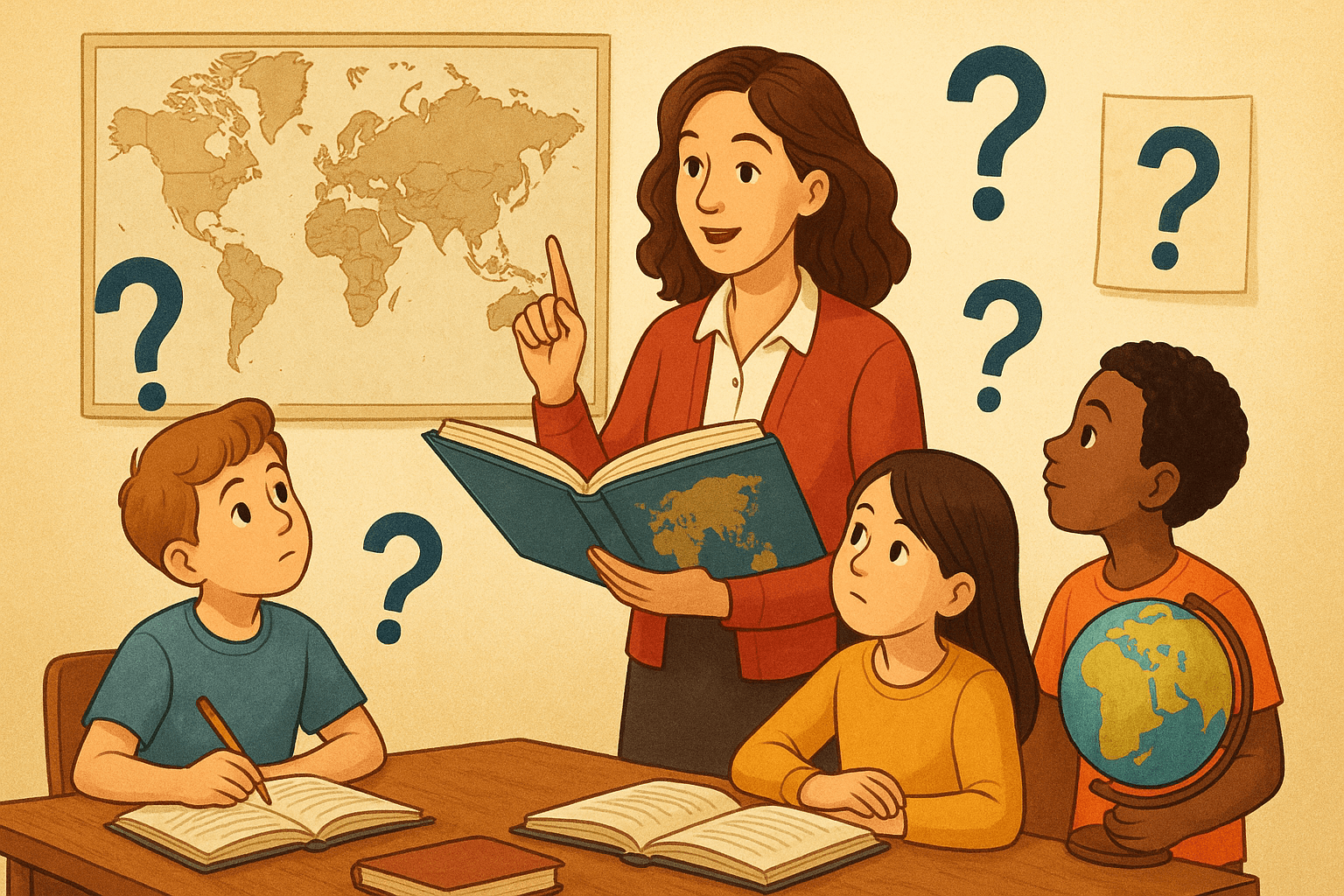
Walk into a typical history classroom, and you might hear students reciting dates, memorizing names, and repeating events in chronological order. “The Declaration of Independence was signed in 1776.” “The Civil War ended in 1865.” “World War II began in 1939.”
It sounds impressive — but often, it’s just memorization. The spark that makes history meaningful is missing.
The most important word in history isn’t when, where, or even what.
It’s why.
When we teach children to ask why, we move beyond surface facts into the rich territory of motivation, consequence, and connection. We shift history from a collection of old stories into a laboratory for reasoning, empathy, and reflection.
This post explores how focusing on the “Why Factor” can transform a history lesson into a training ground for critical thinking, equipping children with the mindset to question, analyze, and understand the world around them.
1. From Memorizing Facts to Understanding Choices
For many students, history feels like a list of random facts — kings, wars, treaties, revolutions — disconnected from real life. But history is not about what happened; it’s about why it happened.
Every event in history was shaped by human choices. Wars began because of fear, ambition, or misunderstanding. Revolutions happened because people demanded change. Civilizations rose and fell based on leadership, innovation, and resources.
When students learn to ask why, they begin to:
- See patterns in human behavior.
- Recognize cause and effect.
- Understand that history is not inevitable — it’s the result of decisions.
Instead of memorizing “The Industrial Revolution began in Britain,” they can explore why Britain was ready for that transformation — looking at geography, trade, politics, and curiosity. That shift turns passive learning into active investigation.
2. The Power of ‘Why’: How Questions Build the Brain
Asking why isn’t just curiosity — it’s neuroscience.
Studies in educational psychology show that inquiry-based learning (where students explore questions instead of memorizing answers) stimulates deeper brain activity. The process activates the prefrontal cortex — the part responsible for reasoning, prediction, and decision-making.
When children ask why, they are not only processing information but connecting it to prior knowledge, forming mental links that improve memory and comprehension.
Example:
- Memorizing: “The Great Depression began in 1929.”
- Asking why: “Why did the stock market crash? Why did banks fail? Why did unemployment spread so fast?”
Now, a simple date becomes a chain of reasoning — economic habits, social systems, and emotional responses. The learner doesn’t just know when it happened; they understand how and why it mattered.
3. Transforming a History Lesson with the ‘Why’ Lens
Let’s imagine a classroom lesson on The American Revolution.
The Traditional Approach:
The teacher lists facts:
- “The war began in 1775.”
- “The colonies wanted independence.”
- “The Treaty of Paris ended the war in 1783.”
The students memorize, repeat, and move on.
The ‘Why’ Approach:
The teacher reframes the lesson through inquiry:
- “Why did colonists start questioning British authority?”
- “Why did taxation become such a big issue?”
- “Why did some colonists remain loyal to Britain?”
- “Why did the Revolution succeed despite overwhelming odds?”
Now, students must think like historians — analyzing motives, trade-offs, and emotions. They debate, infer, and connect. Suddenly, the past feels alive.
They’re not just learning what happened — they’re learning how people think under pressure, how society changes, and how decisions shape outcomes.
4. Why Questions Turn Facts into Stories
The human brain is wired for storytelling. When we understand the motivations behind actions, facts transform into meaningful narratives.
For example:
- Instead of memorizing “Julius Caesar was assassinated in 44 BCE,”
students can explore why his senators turned against him. Was it fear of tyranny? Jealousy? A struggle for power? - Instead of “Women gained the right to vote in 1920,”
students can ask why it took so long — and what changed socially and politically to make it possible.
Asking why reveals emotion, conflict, and growth — the elements that make history relatable. This process develops empathy and ethical reasoning, showing students that behind every date and name, there are human beings making difficult choices.
5. The Teacher’s Role: Guiding Inquiry Instead of Giving Answers
When teaching the “Why Factor,” the teacher becomes a guide, not a lecturer.
Instead of presenting facts, they create space for exploration:
- Encourage students to make predictions before learning the outcomes.
- Ask open-ended questions that invite multiple interpretations.
- Use primary sources (letters, diaries, photos) to let students uncover motives.
For example, instead of saying “The Civil Rights Movement was led by Martin Luther King Jr.,” ask:
“Why did nonviolent protest work better than other methods?”
This shift encourages reasoning. The teacher helps students discover answers rather than receive them.
In doing so, students develop habits of critical inquiry — skills that go beyond history class and apply to every subject, from science to social studies to media literacy.
6. Turning Students into Historical Detectives
A great way to teach “why” is through historical detective work.
Give students a mystery — an event, a conflict, or a social change — and have them piece together evidence to explain why it happened.
Example: The Fall of Ancient Rome
Ask students to investigate:
- Why did Rome’s economy weaken?
- Why did the government lose control?
- Why did invasions succeed after centuries of strength?
Students can explore political corruption, economic decline, moral decay, and external threats. Then they can compare Rome’s situation to modern societies.
The goal isn’t to reach one “correct” answer but to practice reasoning, interpretation, and argument-building — the heart of critical thinking.
7. Linking ‘Why’ to Modern Thinking Skills
Critical thinking is more than academic — it’s a life skill. When students learn to ask why about history, they also learn to question the world today.
Here’s how:
- Media Literacy: They question sources and biases instead of accepting headlines.
- Civic Awareness: They recognize that political and social issues have deep roots and multiple sides.
- Empathy: They learn to see through different perspectives — understanding both heroes and villains.
- Problem Solving: They analyze how small causes can lead to big consequences.
In essence, the Why Factor trains minds to pause before judgment, look beneath the surface, and consider complexity. That’s the foundation of responsible citizenship.
8. How Parents Can Foster the “Why” Habit at Home
You don’t need to be a teacher to encourage deeper thinking. Parents can nurture curiosity at home with simple strategies:
a. Ask reflective bedtime questions
After a history documentary or school project, ask:
- “Why do you think that leader made that decision?”
- “Why did some people agree and others disagree?”
- “Why might that event still matter today?”
b. Make connections
When visiting a museum or watching a movie, relate it to current issues:
“Why do people still fight for equality?”
“Why do countries still go to war?”
c. Encourage curiosity over correctness
Praise questions, not just answers.
When children feel safe to explore ideas, they learn that thinking is an adventure — not a test.
9. Using the ‘Why’ Factor in Modern Education
Educators around the world are shifting toward inquiry-based learning, where students become co-creators of knowledge. History provides a perfect environment for this model because it is filled with open-ended questions.
Practical classroom tools:
- Socratic Circles: Students discuss why events happened and how they relate to current issues.
- Timeline Debates: Instead of listing events, students argue why one event led to another.
- Perspective Journals: Students write from the viewpoint of a historical figure explaining why they made a specific choice.
- Cause and Effect Maps: Visual charts that connect “whys” to outcomes, helping students visualize complexity.
Each strategy transforms history from a subject of memorization into a subject of exploration — where every question opens another door.
10. Overcoming the “Testing Trap”
A common concern teachers face is the pressure of standardized testing. It can seem difficult to balance open-ended inquiry with fixed curricula.
But focusing on why doesn’t mean abandoning facts — it deepens them.
When students understand why something happened, they actually remember facts longer because the knowledge is anchored in meaning.
For example:
- Memorizing “The Berlin Wall fell in 1989” is fleeting.
- Understanding why it fell — because of social unrest, economic failure, and the power of ideas — sticks for life.
Teachers can still meet curriculum goals while fostering curiosity by embedding why questions within factual lessons.
11. The Emotional Dimension: Teaching Empathy Through ‘Why’
Critical thinking isn’t only about logic — it’s also about emotional intelligence.
When students explore why people made certain decisions, they learn empathy.
They begin to see that historical figures were not heroes or villains, but humans dealing with complex choices.
For instance:
- Why did soldiers on both sides of a war believe they were right?
- Why did some people resist social change while others embraced it?
- Why did revolutions begin with hope and sometimes end in tragedy?
These reflections teach children that every perspective has context — a skill that nurtures compassion and open-mindedness in the modern world.
12. The Ripple Effect: From History Class to Real Life
The benefits of the “Why” Factor extend far beyond the classroom.
A student who learns to question why history unfolded as it did will naturally begin asking why things happen today:
- “Why do some communities struggle while others thrive?”
- “Why do governments make certain economic decisions?”
- “Why do cultural values change over time?”
This line of inquiry builds global awareness. It turns students into active thinkers — the kind who can interpret news critically, solve problems creatively, and approach life with curiosity instead of assumption.
13. Reframing the Goal of Education
The ultimate goal of education isn’t just to fill minds with facts. It’s to teach children how to think.
When we bring the “Why Factor” into history lessons, we’re not only teaching about the past — we’re preparing students for the future.
We’re helping them:
- Recognize patterns in behavior and decision-making.
- Understand consequences and accountability.
- See beyond their own perspective.
- Develop resilience in problem-solving.
In a world where information is everywhere, the true skill is not remembering data — it’s understanding it.
14. Conclusion: The Power of Asking ‘Why’
Every event in history, from revolutions to discoveries, started with a question. Someone asked why things were the way they were — and decided to find an answer.
When we teach children to ask why, we give them that same power. We train them to think critically, empathize deeply, and act wisely.
A simple shift from what to why can transform the classroom into a space of discovery — and turn ordinary students into thoughtful, engaged citizens.
The “Why Factor” doesn’t just make better historians.
It makes better thinkers.