
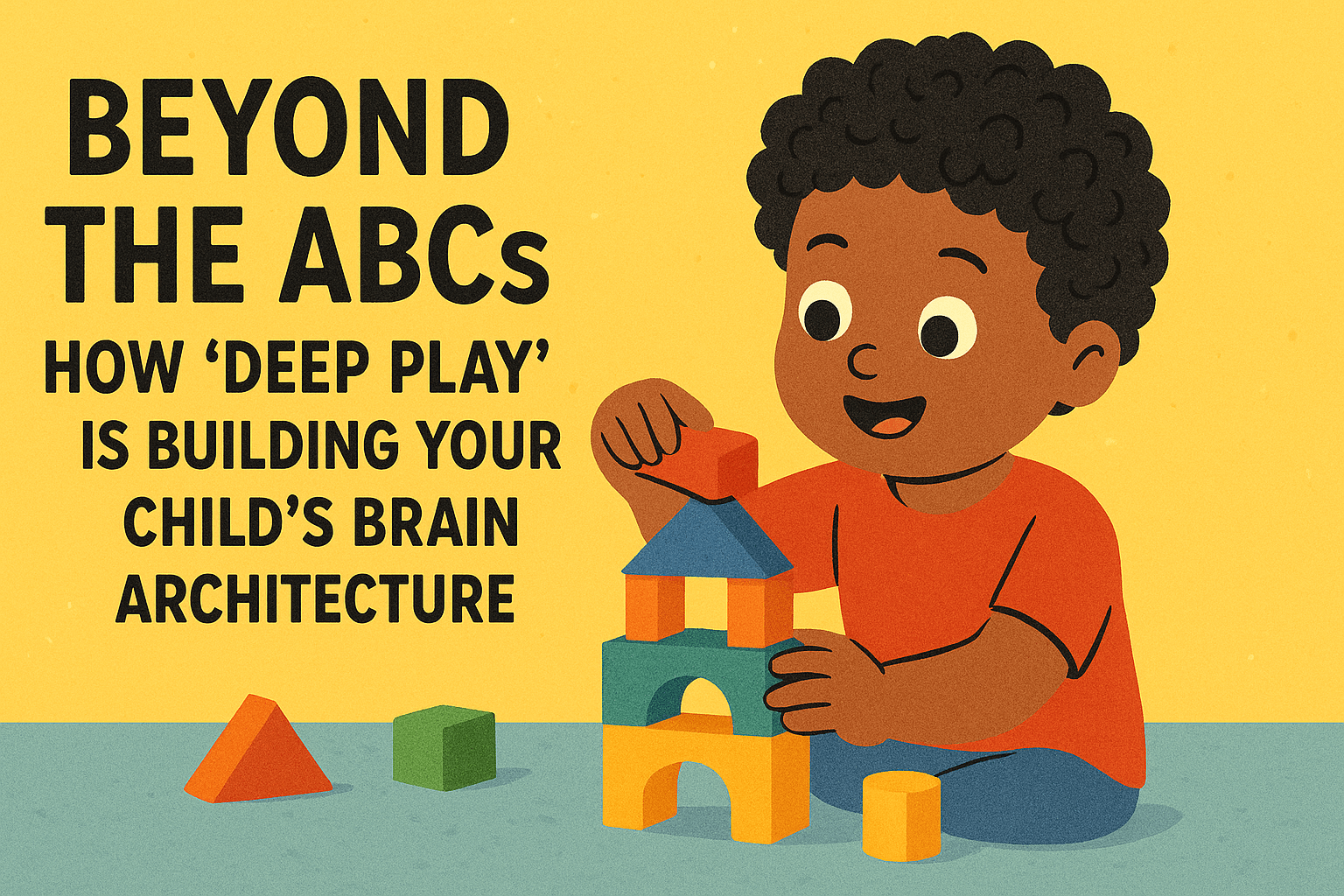
In a world obsessed with early reading scores, coding camps, and academic milestones, it’s easy to overlook one of the most powerful forces shaping a child’s mind: play.
But not just any play. We’re talking about “Deep Play”—the kind of imaginative, fully engaged, joy-driven play that builds the foundation of your child’s brain in ways flashcards and workbooks never could.
While parents often worry about “getting ahead” academically, neuroscience and developmental psychology tell a different story: long before a child learns to recite the alphabet, their brain is wiring itself through exploration, creativity, and curiosity.
This post explores how deep play fuels brain development, why it’s more than just “fun,” and how you can nurture it at home to help your child thrive far beyond the ABCs.
1. What Is Deep Play?
Deep play is a term used to describe intense, self-chosen, and immersive play experiences. It’s when a child becomes completely absorbed in what they’re doing—building forts, creating stories, pretending to be astronauts, or engineering elaborate train tracks.
During deep play, children enter a flow state—their focus sharpens, time seems to disappear, and they experiment freely without fear of mistakes.
Unlike structured play or adult-directed activities, deep play is child-led. There are no rules beyond what the child invents, and no pressure to “perform.” This kind of play is the brain’s natural workshop—where imagination meets problem-solving, and neurons form powerful new connections.
Psychologist Stuart Brown, founder of the National Institute for Play, describes it best:
“Play is not the opposite of work—it’s the foundation of growth.”
2. The Science of Play and the Developing Brain
To understand why deep play matters, we have to peek inside the brain.
A child’s brain is like a construction site during early development. Billions of neurons are forming and pruning connections—a process scientists call “synaptic plasticity.”
Every time your child plays, especially in creative and unstructured ways, these neural circuits strengthen and organize.
Here’s what’s happening beneath the surface:
a. Prefrontal Cortex (Executive Function)
When children plan a game, take turns, or solve play-related problems, their prefrontal cortex—the brain’s “CEO”—is developing. This area controls focus, impulse regulation, and decision-making.
Deep play trains the same mental muscles needed for academic success later on.
b. Hippocampus (Memory and Learning)
In imaginary play, children remember storylines, character roles, and sequences of events. This activates the hippocampus, which helps form long-term memory.
c. Cerebellum (Coordination and Balance)
Physical play—running, climbing, spinning—stimulates the cerebellum, enhancing both motor control and cognitive processing.
d. Limbic System (Emotion Regulation)
When play becomes challenging—like losing a game or rebuilding a toppled tower—children learn emotional resilience. The amygdala and prefrontal cortex collaborate to regulate stress and frustration.
In short: deep play doesn’t just entertain—it literally builds the brain’s architecture.
3. Play vs. Deep Play: What’s the Difference?
| Type of Play | Example | Cognitive Impact |
|---|---|---|
| Structured Play | Teacher-led puzzles, games with rules | Develops logic, discipline |
| Free Play | Playing with toys or friends | Encourages social skills |
| Deep Play | Child-led immersive storytelling, building complex imaginary worlds | Strengthens focus, creativity, and brain connectivity |
Deep play sits at the intersection of freedom and challenge. It’s when children lose themselves in an activity that is both enjoyable and mentally demanding—like figuring out how to balance blocks in a tower that keeps falling.
This kind of play fosters what scientists call “executive function integration”—a blend of self-control, memory, and cognitive flexibility. These skills are far stronger predictors of long-term success than early reading ability.
4. Deep Play Builds More Than Knowledge—it Builds Mindsets
When a child plays deeply, they’re not just learning facts—they’re shaping how they think.
Here’s what deep play teaches beyond the ABCs:
a. Persistence
Building a Lego bridge that keeps collapsing teaches problem-solving and perseverance far better than a worksheet ever could.
b. Curiosity
In play, every “What if?” question becomes an experiment. Children naturally test hypotheses—like little scientists exploring cause and effect.
c. Emotional Regulation
When play gets frustrating or competitive, kids learn to manage disappointment, anger, and stress—skills essential for emotional intelligence.
d. Collaboration
Group play builds empathy, negotiation, and communication. Children learn to share ideas, listen, and compromise—all through natural interaction.
e. Creativity
Every imaginative scenario—a pirate ship, a dragon’s cave, a doctor’s office—activates abstract thinking. The child learns to create possibilities, a skill central to innovation.
5. How Deep Play Shapes Brain Architecture
According to the Harvard Center on the Developing Child, early experiences literally shape the brain’s architecture. Neural connections are formed through repeated, meaningful activity.
Think of the brain as a city under construction:
- Neurons are the buildings.
- Connections (synapses) are the roads.
- Repetition and emotional engagement are the traffic that keeps those roads strong and active.
Deep play creates rich, multi-lane highways between brain regions—connecting emotion, logic, movement, and imagination.
By contrast, purely rote or screen-based learning often forms narrower “roads,” limiting integration across systems.
Neuroscientist Dr. Adele Diamond emphasizes that executive function—our ability to plan, remember, and focus—develops most effectively through active, social, and joyful learning. Deep play ticks all those boxes.
6. The Decline of Deep Play in Modern Childhood
Unfortunately, deep play is becoming a rare luxury.
Research shows that children today spend less time in free play than any generation before. The reasons are clear:
- Over-scheduled routines and early academic pressure
- Screen addiction
- Safety concerns and limited outdoor spaces
- Parental fear of “wasted time”
But what’s lost isn’t just fun—it’s the brain’s natural development process.
A 2019 study from the American Academy of Pediatrics warned that the decline in imaginative play correlates with rising rates of anxiety and attention disorders in children.
Put simply: kids aren’t bored enough to get creative anymore.
7. Deep Play in Action: Real-Life Examples
To visualize deep play, consider these scenarios:
a. The Fort Builders
Two siblings spend an hour creating a “secret base” using cushions, sheets, and chairs. They debate over structure, assign roles, and guard their creation.
Brain boost: planning, collaboration, spatial reasoning.
b. The Mini Scientists
A child fills cups with water, food coloring, and leaves to “make potions.”
Brain boost: hypothesis testing, sensory exploration, focus.
c. The Story Architects
A group of kids turns their playground into a kingdom with rules, leaders, and quests.
Brain boost: leadership, narrative thinking, emotional intelligence.
In all these cases, the learning is profound—yet no adult instruction was required.
8. What Parents Can Do to Encourage Deep Play
Here’s how you can nurture deep play at home—even in small spaces or busy schedules:
a. Create Play Zones
Dedicate a space (even a corner) where toys, art supplies, and building materials are always available. Avoid over-structuring—it’s about invitation, not instruction.
b. Embrace Messy Play
Clay, sand, water, and paint stimulate the senses. Messy play activates the tactile and motor centers of the brain while encouraging creativity.
c. Limit Screen Time
Screens provide stimulation, not imagination. Replace digital entertainment with open-ended play materials—blocks, costumes, cardboard boxes.
d. Let Boredom Happen
When kids complain they’re bored, resist the urge to fill the gap. Boredom sparks imagination—deep play often begins with “nothing to do.”
e. Play With, Not For, Your Child
Join in occasionally as a collaborator, not a director. Follow their lead and let them set the rules—it strengthens trust and independence.
f. Offer Loose Parts
Provide objects without defined purpose—wood scraps, fabric, stones, boxes. Loose parts invite invention and abstract thinking.
g. Celebrate Process, Not Product
Ask questions like, “How did you think of that?” instead of “What did you make?” This reinforces creativity over perfection.
9. Deep Play and Emotional Intelligence
Emotions are the scaffolding of brain development. In deep play, children experience a full emotional spectrum: joy, frustration, excitement, pride, disappointment.
Each emotion offers a chance to practice regulation.
When a tower falls or a game ends unexpectedly, a child learns coping mechanisms: taking deep breaths, retrying, seeking help.
These lessons transfer directly to the classroom and relationships later in life.
Psychologists note that play’s social-emotional lessons are vital to resilience—the ability to recover from setbacks.
10. The Long-Term Benefits of Deep Play
Deep play has lifelong effects that go far beyond childhood.
a. Academic Success
Children who engage in deep play develop stronger executive function, attention control, and creativity—all key predictors of achievement.
b. Emotional Stability
Deep play builds stress tolerance and empathy, reducing the risk of anxiety and behavioral problems.
c. Problem-Solving Skills
Unstructured play strengthens divergent thinking—the ability to approach problems from multiple angles.
d. Social Confidence
Kids who navigate play negotiations learn to handle real-world collaboration and conflict with confidence.
e. Lifelong Curiosity
Playful learners remain curious adults—better innovators, entrepreneurs, and thinkers.
11. The Role of Schools: Integrating Deep Play into Learning
Educators are increasingly realizing that play isn’t a break from learning—it is learning.
Progressive schools now integrate “Play-Based Learning” and “Inquiry-Driven Classrooms” where students explore through projects and experimentation.
When teachers connect curriculum to play, children engage naturally. For example:
- Learning geometry through block building
- Exploring storytelling through drama
- Studying ecosystems through outdoor play
This approach doesn’t sacrifice academics—it enhances them. Deep play builds the mental scaffolding on which literacy, numeracy, and problem-solving rest.
12. The Neuroscience of Joy
One of the most fascinating findings in brain research is that joy amplifies learning.
When children play deeply, the brain releases dopamine and endorphins—chemicals linked to pleasure and motivation. These neurotransmitters enhance neural plasticity, making learning stick.
In other words: when a child is having fun, their brain literally learns faster.
So that laughter in the living room fort? That’s not just noise. It’s the sound of neurons firing and pathways forming.
13. Reclaiming Play in a Busy World
Between digital distractions and academic pressure, deep play can seem like a luxury—but it’s actually a necessity.
The key is to reclaim slow time:
- Unplug for an hour a day.
- Go outdoors without a plan.
- Let your child lead the adventure.
Children don’t need fancy toys or programs—they need time, space, and permission to play deeply.
As educator Maria Montessori said:
“Play is the work of the child.”
14. The Parent’s Deep Play Mindset
Parents often worry: “Am I doing enough to prepare my child?”
But preparation isn’t about flashcards—it’s about creating conditions where curiosity thrives.
Here’s how to adopt a deep play mindset yourself:
- Observe more, direct less.
- Value effort over outcome.
- Trust the process of imagination.
- Celebrate curiosity, not correctness.
Your role isn’t to engineer the perfect childhood—it’s to provide the soil where your child’s ideas can grow.
15. The Future of Learning: A Return to Play
The irony of modern education is that we’re rediscovering ancient wisdom. For centuries, children learned through play—through imitation, exploration, and storytelling.
Now, neuroscience confirms what generations of parents and teachers already knew: play is the engine of learning.
In the future, schools and homes that prioritize deep play will nurture not only smarter children—but whole children: curious, balanced, empathetic, and resilient.
16. Final Thoughts: Building Better Brains, One Game at a Time
Deep play is not a distraction from learning—it’s the blueprint of it.
Every time a child imagines, builds, argues, experiments, or dreams, they’re shaping the architecture of their brain. They’re wiring circuits for creativity, empathy, and intelligence that no worksheet can match.
So next time your child is lost in a cardboard spaceship or an epic pretend adventure, resist the urge to pull them back to “something productive.”
They already are.Because beyond the ABCs lies something far more powerful—
a brain being built, one joyful game at a time.