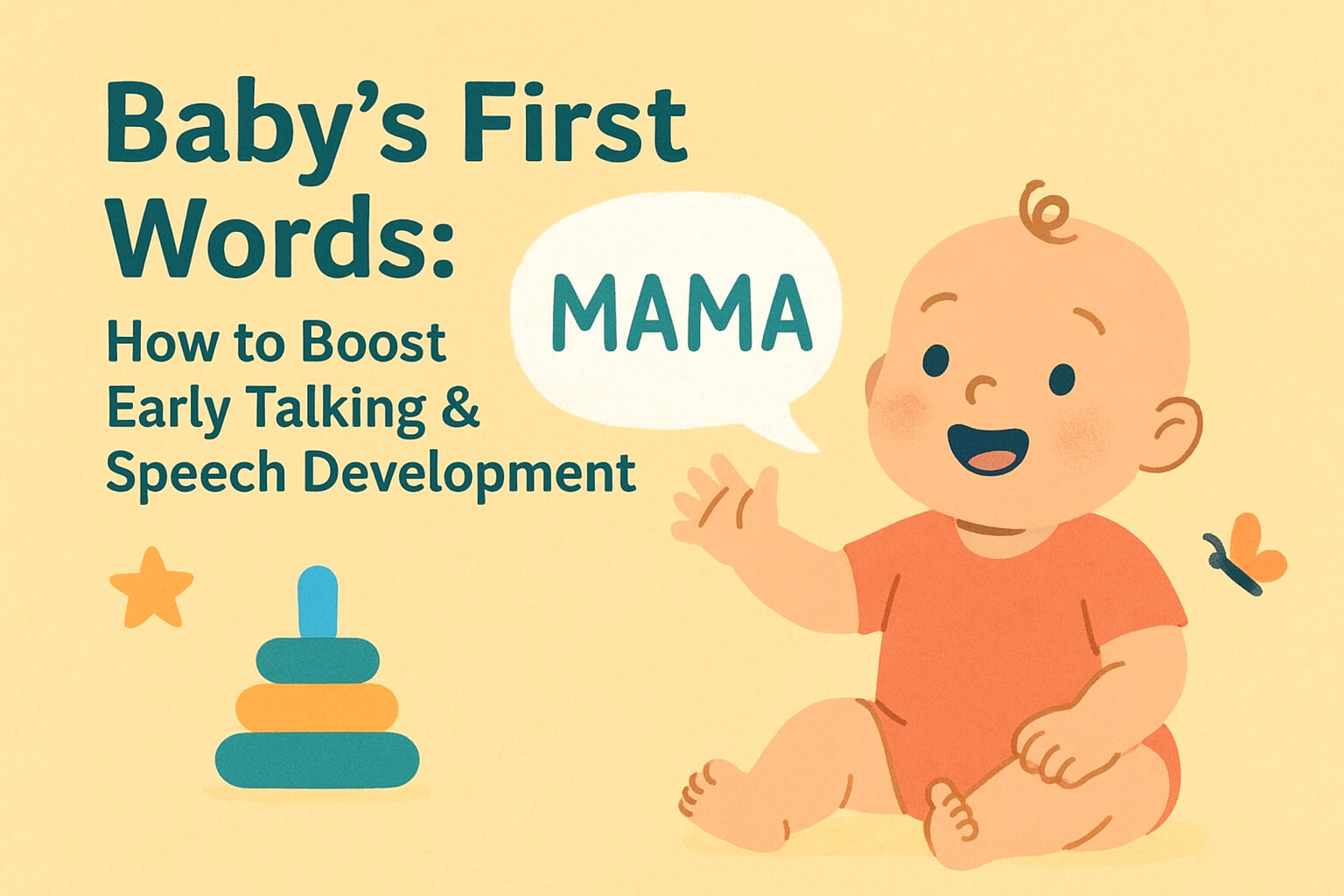
Your baby’s first words—whether it’s “mama,” “baba,” or a cute little babble—are unforgettable. But speech doesn’t begin overnight. It’s a gradual process that starts long before your baby says anything at all. From coos and babbles to full sentences, every stage builds the foundation for strong communication skills.
In this guide, you’ll discover expert-backed tips, activities, and milestones to help your baby talk earlier and more confidently.
Understanding Early Speech Development
Before babies speak actual words, they go through several communication stages:
0–3 Months: Sounds & Awareness
- Coos, gurgles, soft vowel sounds
- Recognizes parents’ voices
- Turns toward sounds
4–6 Months: Babbling Begins
- “Ba-ba,” “ma-ma,” “ga-ga”
- Experiments with pitch and volume
- Starts responding to tone
7–12 Months: Meaningful Sounds
- Understands simple words: “no,” “bye-bye,” “milk”
- Imitates sounds
- First words usually appear around 10–14 months
12–18 Months: Fast Vocabulary Growth
- Uses simple words
- Points and names familiar items
- Combines gestures + words
18–24 Months: Word Explosion
- Learns 10–20 new words per month
- Simple two-word phrases start: “more milk,” “bye mama”
How to Boost Early Talking & Speech Development
Below are the best evidence-based techniques recommended by pediatric speech-language pathologists.
1. Talk to Your Baby—A Lot!
Your voice is the biggest language teacher.
How to do it:
- Describe what you’re doing: “Mommy is cutting apples.”
- Label objects: “This is your teddy bear.”
- Use slow, clear, simple sentences
Why it works:
Babies learn by hearing language repeatedly in natural situations.
2. Respond to All Your Baby’s Sounds
When your baby coos, babbles, or points—respond immediately.
Benefits:
- Strengthens communication
- Shows the baby that sounds create meaning
- Encourages more vocalization
Even responding with “Oh really?” or “Tell me more!” makes a difference.
3. Use “Parentese” (But Not Baby Talk)
Parentese = higher pitch, exaggerated tone, slower speech
Baby talk (nonsense words) = NOT recommended
Example:
Instead of: “Wawa goo goo”
Say: “Do you want waaa-ter?”
Why it helps:
Studies show babies learn words faster when parents use parentese.
4. Read to Your Baby Every Day
Reading is one of the most powerful ways to boost speech.
What to read:
- Board books
- Picture books
- Rhyming books
- Books with animal sounds
Tips:
- Point to pictures as you read
- Let baby touch, flip, explore the book
- Repeat favorite books often
5. Name Everything Around You
Babies learn language through repetition.
Label frequently:
- Body parts
- Foods
- Toys
- Animals
- Places
Try this:
“Here are your shoes! Let’s put your shoes on your feet.”
Repetition = faster word learning.
6. Sing Songs & Nursery Rhymes
Music builds memory and rhythm—two huge tools for speech.
Great options:
- “Twinkle Twinkle Little Star”
- “Baby Shark”
- “Old MacDonald Had a Farm”
Why it works:
Songs break language into small, easy patterns.
7. Encourage Gestures
Gestures support early communication and lead to earlier speech.
Useful gestures:
- Waving
- Pointing
- Clapping
- Blowing kisses
- Shaking head for “no”
Babies who point and gesture often learn words earlier.
8. Follow Your Baby’s Lead
Talk about what your baby is interested in, not what you plan.
Example:
If baby looks at the window, you say:
“Do you see the bird? The bird is singing!”
This builds connection + learning.
9. Use Simple Choices to Encourage Talking
Give your baby small options.
“Do you want milk or water?”
“Should we read this book or that book?”
If the baby points, repeat the word:
“You want milk!”
Repeated labeling helps vocabulary grow.
10. Limit Screen Time (Under 18 Months)
Pediatricians strongly advise:
❌ No screens
✔ Yes to face-to-face interaction
Babies learn to talk through real human connection, not screens.
Fun Activities to Boost Speech Development
1. Animal Sound Play
Show animal toys and mimic sounds:
- “Cow says mooo!”
- “Dog says woof woof!”
Babies can imitate sounds earlier than words.
2. Mirror Talk
Babies love watching themselves.
Sit in front of a mirror and label:
- Eyes
- Nose
- Mouth
- Ears
3. Peek-a-Boo
This classic game teaches:
- Social communication
- Object permanence
- Turn-taking
All important for speech.
4. Picture Cards
Use simple flashcards with:
- Animals
- Fruits
- Vehicles
Name each picture slowly.
5. Toy Rotation Game
Hold two toys, let baby choose.
This encourages pointing + naming.
Common First Words
These are usually easiest because they’re simple and meaningful:
- Mama
- Dada
- Baba
- Hi
- Bye
- No
- Ball
- Milk
- Dog
- More
- Up
- All done
Every baby is different—some speak earlier, some later.
Red Flags to Watch For
Consider speaking with a pediatrician or speech therapist if your baby:
- Doesn’t babble by 6–7 months
- Doesn’t respond to name by 9 months
- Says no words by 15 months
- Can’t follow simple instructions by 18 months
- Has hearing issues
- Only uses gestures, no sounds
Early support helps tremendously.
Frequently Asked Questions
When do babies say their first words?
Most babies say their first real word between 10–14 months.
Should I correct my baby’s mispronunciations?
No—repeat the word correctly without scolding.
Baby: “Ba!”
Parent: “Yes! That’s your ball!”
Is bilingual exposure okay for speech?
Yes, completely safe. Bilingual babies may talk slightly later, but develop stronger language skills long-term.
How many words should a 1-year-old say?
Usually 2–5 words, but understanding is far more important than speaking.
Final Thoughts
Boosting your baby’s speech development doesn’t require expensive toys or programs. Your baby learns to talk through:
- Your voice
- Play
- Reading
- Connection
- Repetition
- Loving interaction
Talk often. Read daily. Respond with warmth.
With consistency, your baby’s first words will come naturally—and beautifully.