
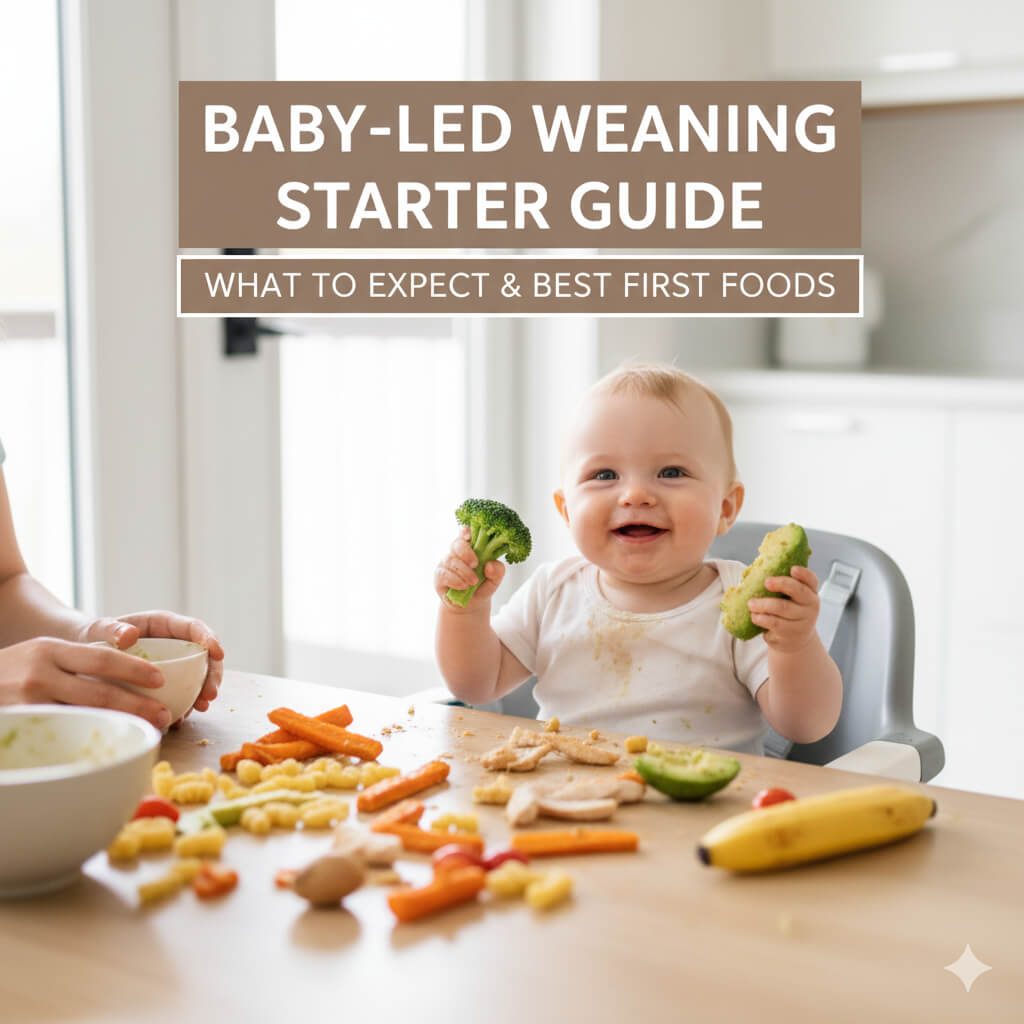
Starting solid foods is one of the most exciting milestones in your baby’s first year. If you’ve heard about baby-led weaning (BLW) and are curious whether it’s right for your family, you’re not alone. Many parents are choosing this approach because it encourages independence, healthy eating habits, and family mealtime participation from the very beginning.
This Baby-Led Weaning Starter Guide will walk you through what baby-led weaning is, when and how to start, what to expect, safety tips, and the best first foods—all in a simple, beginner-friendly way.
Whether you’re completely new to BLW or just looking for clarity, this guide will help you start with confidence.
What Is Baby-Led Weaning?
Baby-led weaning is a method of introducing solid foods where babies feed themselves from the start, instead of being spoon-fed purees. Babies eat soft, appropriately sized finger foods and decide how much and how fast to eat.
In baby-led weaning:
- Babies sit upright and feed themselves
- Foods are offered in graspable shapes
- Parents choose what food is offered
- Babies decide how much they eat
Breast milk or formula remains the main source of nutrition until age one, while solids are about exploration, skill development, and learning to enjoy food.
When Can You Start Baby-Led Weaning?
Most babies are ready for baby-led weaning at around 6 months, but readiness matters more than age.
Signs Your Baby Is Ready for BLW:
- Can sit upright with minimal support
- Has good head and neck control
- Brings objects to their mouth
- Has lost the tongue-thrust reflex
- Shows interest in food
If your baby is not yet sitting well or bringing food to their mouth, it’s best to wait. Always consult your pediatrician if you’re unsure.
Baby-Led Weaning vs Traditional Spoon-Feeding
| Baby-Led Weaning | Traditional Weaning |
|---|---|
| Baby feeds themselves | Parent spoon-feeds |
| Finger foods from start | Purees first |
| Baby controls intake | Parent controls portions |
| Encourages independence | More parent-directed |
Many families choose a combined approach, using both BLW and spoon-feeding. There is no one “right” way—what matters most is safety and responsiveness.
What to Expect When Starting Baby-Led Weaning
Baby-led weaning looks different from traditional feeding, especially in the beginning.
1. Messy Mealtimes
BLW is messy—very messy. Food will end up on the floor, chair, baby’s face, and hair. This is normal and part of learning.
2. Small Amounts Eaten
At first, your baby may barely swallow anything. That’s okay. Touching, licking, and tasting are all part of the process.
3. Gagging (Not Choking)
Gagging is common and normal. It helps babies learn how to move food safely in their mouth. Choking is silent and dangerous, but gagging is noisy and protective.
4. Gradual Skill Development
Babies learn how to bite, chew, and swallow over time. Confidence improves with practice.
Baby-Led Weaning Safety Tips (Very Important)
Safety is the most important part of BLW.
Always Follow These Rules:
- Baby must sit upright (not reclined)
- Always supervise meals
- Offer soft, easily mashable foods
- Avoid small, round, hard foods
- Learn the difference between gagging and choking
Foods to Avoid (Choking Risks):
- Whole grapes
- Nuts and popcorn
- Raw carrots or apples
- Sausages cut into rounds
- Sticky foods like spoonfuls of peanut butter
Cut foods into large sticks or spears and cook until soft.
How to Prepare Foods for Baby-Led Weaning
Food Texture Rule
You should be able to easily mash the food between your fingers.
Food Shape Rule
Foods should be:
- Finger-length
- Easy for baby to grasp
- Soft enough to gum
Best First Foods for Baby-Led Weaning
The best BLW foods are soft, nutritious, and easy to hold.
1. Avocado Slices
Why: Healthy fats for brain development
How to serve: Peeled, sliced into thick wedges
2. Steamed Sweet Potato
Why: Rich in vitamin A and naturally sweet
How to serve: Soft sticks or wedges
3. Banana
Why: Easy to digest and naturally soft
How to serve: Cut lengthwise into halves or thirds
4. Steamed Carrot Sticks
Why: Supports eye health and immunity
How to serve: Cook until very soft, cut into long sticks
5. Soft Pear or Apple Slices
Why: Gentle fiber and vitamins
How to serve: Steam or bake until soft
6. Steamed Broccoli Florets
Why: High in iron and vitamin C
How to serve: Soft florets with long stems
7. Scrambled Eggs
Why: Great source of protein and iron
How to serve: Soft, large curds
(Always fully cook eggs.)
8. Oatmeal Fingers
Why: Iron-rich and filling
How to serve: Thick oatmeal cut into strips
9. Soft Cooked Pasta
Why: Easy to hold and chew
How to serve: Large shapes like penne or fusilli
10. Soft Chicken Strips
Why: Excellent iron source
How to serve: Very tender, shredded or large soft strips
Introducing Allergens in Baby-Led Weaning
Early introduction of allergens may reduce allergy risk.
Common Allergens:
- Peanut
- Egg
- Dairy
- Wheat
- Fish
Introduce one allergen at a time, in small amounts, during the day (not at night), and watch for reactions.
Never give whole nuts or thick nut butter—use thin spreads or mixed forms.
How Much Should a Baby Eat With BLW?
There is no set amount.
- Some meals: baby eats a lot
- Other meals: baby eats very little
Trust your baby’s hunger cues. Breast milk or formula remains the primary nutrition until age one.
Sample Baby-Led Weaning Meal Ideas
Breakfast
- Banana spears
- Soft scrambled egg
Lunch
- Steamed sweet potato
- Avocado slices
Dinner
- Soft pasta
- Steamed broccoli
Common Baby-Led Weaning Mistakes to Avoid
- Starting too early
- Offering unsafe foods
- Expecting baby to eat full meals immediately
- Pressuring baby to eat
- Comparing your baby to others
BLW is about learning, not perfection.
Baby-Led Weaning Cleaning Tips
- Use a splat mat under the chair
- Dress baby in a simple bib or old clothes
- Let baby play with food—it builds skills
- Clean baby after the meal, not during
Is Baby-Led Weaning Right for Every Baby?
Baby-led weaning works well for many families, but it’s not mandatory. Some babies need more time, and some parents prefer a mixed approach.
What matters most is:
- Baby safety
- Responsive feeding
- Positive mealtime experiences
You know your baby best.
Final Thoughts
Baby-led weaning is a wonderful way to help your baby develop independence, motor skills, and a healthy relationship with food. While it may feel messy and unpredictable at first, it becomes easier with time and practice.
Start slowly, focus on safety, offer a variety of healthy foods, and trust your baby’s cues. Mealtimes should be relaxed, enjoyable, and pressure-free.
Every baby learns at their own pace—and that’s perfectly okay.