
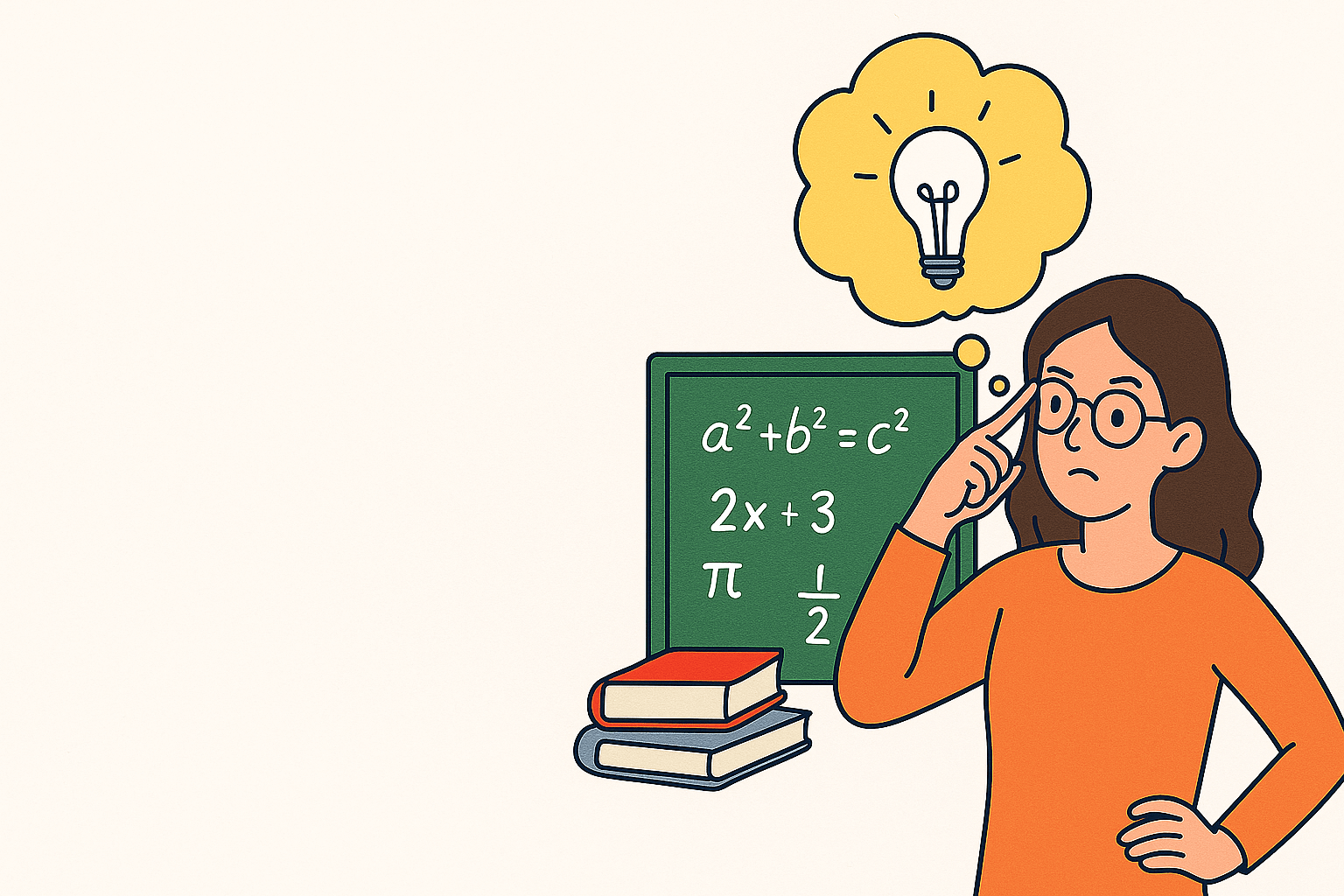
The Great Math Myth
“Some people are just not math people.”
It’s a phrase many of us have heard — and perhaps even said — when facing a tricky equation or a confusing word problem. But here’s the truth: there’s no such thing as a “math brain.”
Neuroscientists, educators, and psychologists agree that our math abilities aren’t fixed — they grow with the right kind of practice, mindset, and environment. The belief that you’re “bad at math” is one of the most damaging myths children inherit. And parents often (unintentionally) pass it on.
This post dives deep into how you can rewrite the math story for your child (and maybe even for yourself). We’ll uncover the research behind math anxiety, explain how the growth mindset transforms learning, and share actionable ways to nurture mathematical confidence from the earliest years.
1. Where the Myth Begins
Children aren’t born with math fear — they learn it.
And surprisingly, it often starts with well-meaning adults.
When parents say things like:
- “I was never good at math either.”
- “Don’t worry, you’re more of a creative person.”
- “Let’s just get through this part.”
They send subtle signals that math is an exclusive club — that you either have the talent or you don’t.
In reality, math is a language of patterns, logic, and persistence — not an IQ test. Just like reading or drawing, it’s a skill built over time through mistakes, practice, and curiosity.
Children mirror our attitudes. If we treat math as intimidating, they internalize that fear. But if we approach it with curiosity (“Let’s figure this out together”), we open the door to lifelong learning.
2. What Science Says About the “Math Brain”
The idea that some people are “wired” for math is outdated.
Modern brain research shows that everyone’s brain can grow new connections through effort and challenge — a concept central to the growth mindset, developed by psychologist Dr. Carol Dweck at Stanford University.
When children engage in problem-solving, their brains form new neural pathways. Struggle isn’t a sign of failure — it’s a sign of growth.
Dr. Jo Boaler, a mathematics education expert, explains that mistakes light up the brain — literally. MRI scans show increased activity when students make errors and reflect on them. That’s when learning actually happens.
So, being “bad at math” isn’t about intelligence — it’s about experience and attitude. The more we normalize challenge, the stronger those mental muscles become.
3. The Fixed vs. Growth Mindset: What’s the Difference?
Let’s break it down simply:
| Mindset Type | Belief | Reaction to Mistakes | Result |
|---|---|---|---|
| Fixed Mindset | “I’m just not good at math.” | Avoids challenges; gives up easily | Stagnates |
| Growth Mindset | “I can get better with practice.” | Embraces mistakes; learns from them | Improves steadily |
When children have a fixed mindset, they see failure as proof that they’re not capable. With a growth mindset, failure becomes feedback — a clue to what to try next.
Example:
A child solving 4 × 7 might say:
- Fixed mindset: “I can’t remember this one. I’m bad at multiplication.”
- Growth mindset: “I don’t remember yet. Let me try skip-counting to find it.”
The difference seems small but changes everything about how they approach learning.
4. The Role of Parents: The Mirror Effect
Children’s attitudes toward math reflect their parents’ emotions about it.
If math was stressful for you in school, it’s easy to pass that unease down.
But here’s the empowering part — you can change that narrative together.
Parents don’t need to be math experts; they just need to model a learner’s mindset.
Try saying:
- “Math can be tricky, but tricky is good — it means our brain is growing.”
- “Let’s figure it out step by step.”
- “I didn’t get this right away either, but I learned.”
When your child sees you treating math as a puzzle, not a problem, they follow your lead.
5. Math Anxiety: The Silent Confidence Killer
Math anxiety is real — a physiological response that can shut down working memory and focus.
Kids who feel anxious often know the right answers but freeze during tests or time pressure.
Common triggers include:
- Fear of making mistakes publicly
- Negative feedback from teachers or peers
- Comparing themselves to “faster” classmates
- Timed drills or pressure-based teaching
What helps:
- Slow it down: Emphasize accuracy and reasoning over speed.
- Normalize errors: Turn mistakes into discussions, not corrections.
- Reframe language: Replace “That’s wrong” with “Let’s try another way.”
The goal is to make math feel like an exploration, not an exam.
6. Turning Struggle into Strength
Here’s a secret: every great mathematician struggles.
Einstein once said, “It’s not that I’m so smart, it’s just that I stay with problems longer.”
The difference between a confident math learner and a frustrated one is resilience — the ability to stay with confusion long enough to see patterns emerge.
You can help your child develop that resilience by celebrating the process, not just the outcome.
Say:
- “I love how you didn’t give up.”
- “You found a new strategy — that’s what mathematicians do.”
- “Let’s see if we can find another way to check your answer.”
This helps your child associate effort with pride, not frustration.
7. Math Is More Than Numbers
Many children who say “I hate math” don’t actually hate math — they hate how it’s taught.
Traditional math often focuses on procedures instead of curiosity.
The truth is, math is everywhere:
- In art (patterns, symmetry, ratios)
- In nature (Fibonacci spirals, honeycombs)
- In cooking (fractions, measurements, scaling recipes)
- In games (strategy, probability, logic)
By connecting math to real-world experiences, you show your child that math isn’t abstract — it’s alive.
Try these:
- Let your child measure ingredients for a recipe.
- Count steps or estimate distances on walks.
- Compare prices during grocery shopping.
- Build Lego structures using pattern challenges.
Math isn’t confined to a worksheet — it’s woven into everyday decisions.
8. How Teachers Use Growth Mindset in Math Class
More schools are now integrating growth mindset strategies into math instruction. Teachers are shifting from “getting the right answer fast” to understanding the thinking process.
Examples of classroom strategies:
- Error analysis: Students learn to celebrate and discuss mistakes together.
- Math journals: Kids write reflections about how they solved a problem and what they learned.
- Collaborative problem-solving: Students work in teams to explore multiple approaches.
- Visual models: Teachers use drawings, manipulatives, and number lines to make abstract ideas tangible.
These methods help every student feel that success is possible — and that their brain grows with each new challenge.
9. From Frustration to Flow: Building Confidence Step-by-Step
If your child often says, “I’m just not good at math,” try this gradual confidence-building plan:
Step 1: Small Wins
Start with problems slightly below their current level to rebuild confidence.
Celebrate effort and completion, not just correctness.
Step 2: Reflect on Mistakes
After an error, ask:
- “What part was confusing?”
- “What helped you get closer?”
Reflection strengthens metacognition — thinking about thinking.
Step 3: Visual Learning
Use diagrams, colors, or real objects. Many children labeled “bad at math” are actually visual learners who just need to see math differently.
Step 4: Growth Vocabulary
Shift household language:
- Replace “I can’t” with “I can’t yet.”
- Replace “This is hard” with “This is helping my brain grow.”
These small shifts reshape your child’s inner dialogue.
10. Practical Growth Mindset Activities for Parents and Kids
Here are some playful, mindset-building ideas to make math exciting again:
1. “My Brain Grows” Journal
Have your child record something new they learned or a problem they solved each week.
This reinforces progress and reflection.
2. Math Role Models
Share stories of famous mathematicians who struggled — like Katherine Johnson (NASA) or Albert Einstein — to show that genius grows from persistence, not perfection.
3. Puzzle Night
Instead of test-style worksheets, try puzzles, riddles, or logic games that spark creativity.
4. The ‘Yet’ Wall
When someone says “I can’t,” add the word “YET” to the sentence.
Post it visibly as a reminder of growth.
5. Teach Back
Have your child teach you a math concept.
Teaching reinforces understanding and boosts confidence.
11. The Parent Reset: Healing Your Own Math Story
If math once intimidated you, this is your chance to rewrite your narrative.
Ask yourself:
- What messages did I receive about math as a child?
- How can I model curiosity instead of fear now?
You don’t need to solve every problem — just show that you’re willing to try.
Your attitude becomes your child’s lifelong math compass.
Instead of saying, “I was never good at math,” try:
“I used to think I wasn’t a math person, but now I know everyone can improve.”
That statement alone reframes your entire family’s math mindset.
12. The Power of “Productive Struggle”
The most powerful learning happens just beyond comfort — what educators call the “zone of proximal development.”
That’s the sweet spot where tasks are challenging, but not impossible.
Encourage your child to stay in that zone — even when frustrated.
It’s like strength training for the brain: the struggle builds the muscle.
Mantra:
“If it feels hard, it means it’s working.”
You can even post that near your study area as a daily reminder.
13. Rethinking Assessment: Beyond Grades
Grades and timed tests often reinforce the fixed mindset.
But math understanding is multi-layered — and can’t always be captured by a score.
Encourage teachers (and yourself) to look for:
- Persistence
- Creativity in problem-solving
- Ability to explain reasoning
Ask your child:
“How did you get that answer?” instead of “Is that right?”
This shifts the focus from performance to process — the heart of a growth mindset.
14. Tech Tools That Build Math Confidence
When used intentionally, technology can transform math anxiety into engagement.
Try these tools:
- Prodigy Math Game – gamified math practice tied to curriculum levels
- Khan Academy Kids – adaptive, mastery-based learning for younger students
- Numberblocks (YouTube) – visual math storytelling for early learners
- Desmos – creative graphing for middle and high school students
Let your child use screens not for distraction, but for discovery. Technology becomes powerful when paired with reflection and purpose.
15. The Long Game: Raising Mathematical Thinkers
At its core, math isn’t about memorizing formulas. It’s about learning to think logically, persevere, and stay curious — skills that transfer to every aspect of life.
When children believe they can improve, they take risks, explore deeper, and approach problems creatively.
That’s the true goal — not producing “math geniuses,” but confident problem solvers who see every challenge as a chance to grow.
Rewriting the Math Story
The next time your child says, “I’m bad at math,” pause — and remind them (and yourself):
“You’re not bad at math. You’re just in the middle of learning it.”
The fixed mindset builds walls; the growth mindset builds bridges.
And the more you and your child walk that bridge together, the stronger it becomes.
Math is not a life sentence — it’s a lifelong journey.
With encouragement, patience, and a belief in growth, every child can move from math anxiety to math empowerment.