
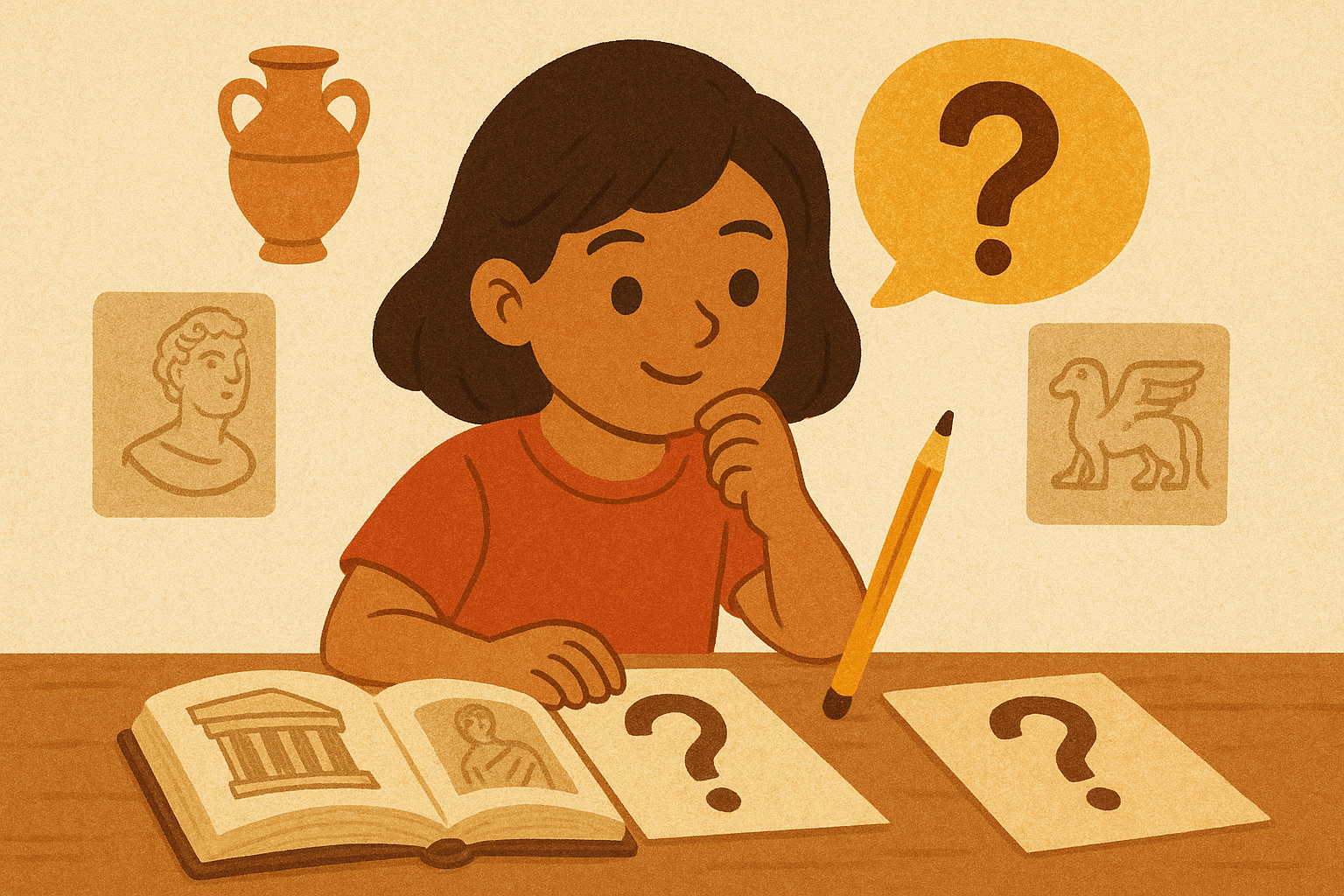
When most children think of history class, they imagine timelines, dusty textbooks, and long lists of dates to memorize. “1492, Columbus sailed the ocean blue,” or “1776, Declaration of Independence.” While these details have their place, this kind of rote learning often leaves students disengaged — memorizing facts without understanding the why behind them.
The truth is, history isn’t about dates. It’s about decisions. Every historical event — from revolutions to reforms — is a story of human choices shaped by context, values, and consequences. And teaching children to explore these whys can ignite one of the most powerful cognitive tools of all: critical thinking.
When students learn to question why events happened, consider multiple perspectives, and analyze the ripple effects of decisions, they are no longer passive recipients of information. They become detectives of the human story — thinkers who understand cause and effect, bias, motivation, and consequence.
Let’s explore how the “Why” factor can turn an ordinary history lesson into a quest for reasoning, empathy, and lifelong curiosity.
1. The Problem with the “What” Approach to History
For decades, history has been taught as a series of “whats” — what happened, what year it was, what leaders were involved. But this focus on surface-level facts often limits deep understanding.
A student might know that the French Revolution began in 1789 but have no clue why ordinary citizens stormed the Bastille. Without the context of inequality, hunger, and anger at absolute power, the event is stripped of meaning.
In this traditional model:
- Students memorize rather than analyze.
- Lessons feel detached from their own lives.
- Teachers are pressured to “cover content” instead of cultivating inquiry.
This approach fails to develop the mental muscles that matter most in real life — reasoning, problem-solving, and perspective-taking.
If we want to prepare students for the complexity of modern society, we must shift history teaching from “What happened?” to “Why did it happen?”
2. Why ‘Why’ Matters: The Cognitive Science of Inquiry
Cognitive research shows that question-driven learning significantly boosts retention and understanding. When students ask why, they activate deeper layers of processing in the brain’s prefrontal cortex — the region responsible for logic, planning, and emotional intelligence.
In other words, curiosity changes how the brain learns.
When children are encouraged to ask why, they:
- Form connections between events and ideas.
- Compare motives and outcomes.
- Develop empathy by seeing through others’ eyes.
- Strengthen problem-solving skills, since history is full of conflicts and decisions.
A simple shift in phrasing — from “What happened in 1914?” to “Why did World War I start?” — transforms a passive question into an active one. Now the learner must investigate, hypothesize, and reason.
This form of inquiry not only deepens historical understanding but also builds transferable critical thinking skills that students can apply to science, social issues, and even personal decision-making.
3. The ‘Why’ Factor in Action: Reimagining a Lesson
Let’s take a familiar topic — the American Civil Rights Movement — and see how the “Why” approach transforms it.
Traditional Approach:
Students memorize key figures (Martin Luther King Jr., Rosa Parks) and major events (Montgomery Bus Boycott, March on Washington).
Why-Focused Approach:
Students explore questions such as:
- Why did segregation persist for so long despite constitutional equality?
- Why did nonviolent protest become the movement’s most powerful weapon?
- Why did some people resist change, and what fears fueled their opposition?
Through these “whys,” learners begin to understand that historical events are not inevitable — they are shaped by human emotion, choice, and belief. This process also encourages moral reasoning: understanding justice, power, and courage.
The same principle can be applied to any era:
- Ancient Egypt: Why did they build pyramids?
- World War II: Why did nations follow certain leaders?
- Industrial Revolution: Why did progress come with social cost?
Each question unlocks complexity and turns history into a living investigation rather than a static record.
4. Encouraging Students to Ask Better Questions
One of the most powerful ways to teach critical thinking is to let students lead the inquiry. Instead of delivering answers, guide them to develop their own why questions.
Here are practical classroom or at-home strategies:
a. The Question Ladder
Start with simple factual questions and climb toward deeper analytical ones.
- Level 1 (Fact): What happened during the Boston Tea Party?
- Level 2 (Reason): Why were colonists angry about British taxes?
- Level 3 (Analysis): Why did protest become the chosen strategy over diplomacy?
- Level 4 (Ethical): Why do people sometimes break the law to stand up for justice?
b. The “Cause and Ripple” Map
Draw a central event on paper and have students trace its causes and effects like ripples in water.
This helps them visualize interconnected thinking — a key element of systems reasoning.
c. The Empathy Exercise
Ask students to write a short journal entry from the perspective of someone in history. For example, “Write as if you were a soldier at Gettysburg or a nurse during the plague.”
Then discuss why that person made the choices they did.
These exercises transform history from memorization to imagination — where reasoning and emotion work together to shape understanding.
5. Linking the ‘Why’ Factor to Critical Thinking Frameworks
Critical thinking isn’t just about asking questions — it’s about evaluating evidence, identifying bias, and forming conclusions.
Here’s how historical “why” questions naturally align with key thinking skills:
| Critical Thinking Skill | History Application | Example |
|---|---|---|
| Analysis | Break down causes of events | Why did alliances contribute to WWI? |
| Inference | Read between the lines of sources | Why might a propaganda poster exaggerate enemy actions? |
| Evaluation | Judge credibility and bias | Why is one eyewitness account more reliable than another? |
| Synthesis | Combine information to form a new idea | Why do revolutions share similar patterns across cultures? |
| Reflection | Apply lessons to today | Why do some modern protests mirror those from the past? |
By framing lessons around why, teachers guide students to practice critical reasoning without formal lectures on logic or debate. They learn to think like historians — questioning, comparing, and synthesizing evidence.
6. The Role of Teachers and Parents: Cultivating the Curiosity Habit
The “Why” Factor works best when adults model it. Children often mirror the inquiry habits they see.
Here’s how educators and parents can foster this mindset:
a. Be a Co-Investigator
Instead of always having the answer, show curiosity yourself:
“That’s interesting — why do you think that leader made that choice?”
When adults admit they don’t know everything, children learn that discovery is ongoing and that it’s okay to wonder.
b. Value Process Over Perfection
Reward students for asking thoughtful questions or revising their assumptions — not just for getting correct answers.
Critical thinking is a process of refinement, not performance.
c. Connect the Past to the Present
Link historical “whys” to modern parallels.
For example:
- “Why did the Great Depression happen?” → “Why do economies still face recessions today?”
- “Why did people migrate during wars?” → “Why do refugees move across borders now?”
When students see the continuity between past and present, they realize history is not just old stories — it’s an ongoing conversation about human behavior.
7. Turning History Class into a Critical Thinking Lab
Imagine a classroom where students become historians, not just learners.
They debate motives, compare perspectives, and use evidence to back up arguments.
a. The Inquiry Cycle
- Ask a compelling why question.
- Gather multiple sources (letters, maps, interviews).
- Analyze motives and biases.
- Discuss alternative interpretations.
- Reflect on what they’ve learned and why it matters.
This process turns the classroom into a critical thinking lab — one where students don’t just learn about democracy, justice, or power, but actually practice these principles through discussion and reasoning.
b. Collaborative “Why” Projects
Assign groups to research different “whys” behind the same event.
For instance, during a unit on colonization, one team could ask:
- “Why did explorers seek new lands?”
Another might ask: - “Why did native populations resist or adapt?”
When the groups share their findings, the class gains a multi-perspective understanding of history — and learns the value of diverse viewpoints.
8. How the ‘Why’ Factor Builds Lifelong Skills
The benefits of this approach go far beyond history class.
Students who learn to ask why develop competencies essential for modern life:
- Media Literacy: They question sources before believing or sharing information.
- Problem Solving: They analyze root causes instead of treating symptoms.
- Empathy: They see issues through multiple human lenses.
- Civic Awareness: They understand how past decisions shape current events.
- Growth Mindset: They value learning as exploration, not memorization.
In a world flooded with information and misinformation, the ability to think critically — to ask why before what — is not optional. It’s survival.
9. Overcoming Barriers: Time, Testing, and Tradition
Of course, teachers often face pressure to cover standardized material quickly. Asking “why” can feel like a luxury in a test-driven system.
But inquiry-based teaching doesn’t have to take more time — it just reframes how we present content.
Instead of listing ten causes of the Renaissance, invite students to discover them through guided “why” discussions. They’ll remember fewer facts but retain deeper insights.
Digital tools also make inquiry easier. Interactive timelines, primary-source archives, and virtual museum tours help students explore their questions at their own pace.
When we prioritize depth over breadth, history becomes not a burden of recall but a joy of discovery.
10. Conclusion: The Power of Asking ‘Why’
Every generation faces its own challenges — social, political, environmental. To meet them, we need citizens who don’t just know what happened in the past, but who can think about why it happened and how it might happen again.
Teaching history through the “Why” Factor transforms education from memorization into meaning-making.
It trains children to connect, compare, and critically evaluate the world — to move from rote learning to reflective thinking.
When a student starts asking why, they are no longer learning about history — they are learning to understand humanity itself.
And that, ultimately, is the deepest purpose of education.