
The first three years of a child’s life are a period of unparalleled neurological expansion. During this window, the brain is more plastic and receptive to learning than it will ever be again. While it may seem like your baby is simply “playing” when they drop a spoon or stare at a ceiling fan, they are actually hard at work. They are performing physics experiments, practicing facial recognition, and building the foundational structures for memory, logic, and abstract thought.
As parents, we often feel the pressure to “teach” our babies. However, brain-boosting isn’t about flashcards or toddler-targeted software. It is about responsive play. The most complex computer in the known universe—the human brain—is powered by simple, everyday interactions.
In this guide, we will explore the science of infant cognition and provide a comprehensive list of activities designed to sharpen memory, improve executive function, and foster critical thinking skills from birth to eighteen months.
The Science of the “Baby Brain”
To understand why certain games work, we must understand what is happening inside the cranium. At birth, a baby’s brain contains nearly all the neurons it will ever have, but very few connections between them. These connections, called synapses, are formed through experience.
1. Working Memory
This is the ability to hold and manipulate information over short periods. When a baby looks for a hidden toy, they are using working memory to remember that the toy still exists even though it is out of sight.
2. Cognitive Flexibility
This allows a child to switch their focus or adapt to new rules. For example, if a baby learns that a red ball bounces but a red apple does not, they are practicing cognitive flexibility.
3. Inhibitory Control
This is the beginning of “thinking before acting.” While a six-month-old has almost no impulse control, games that require waiting (like “Ready, Set, Go!”) begin to build these vital neural pathways.
Activities for Newborns to 4 Months: The Foundation of Recognition
At this stage, memory is fleeting. However, babies are primed for pattern recognition. They are learning to distinguish familiar voices from strangers and high-contrast shapes from blurry backgrounds.
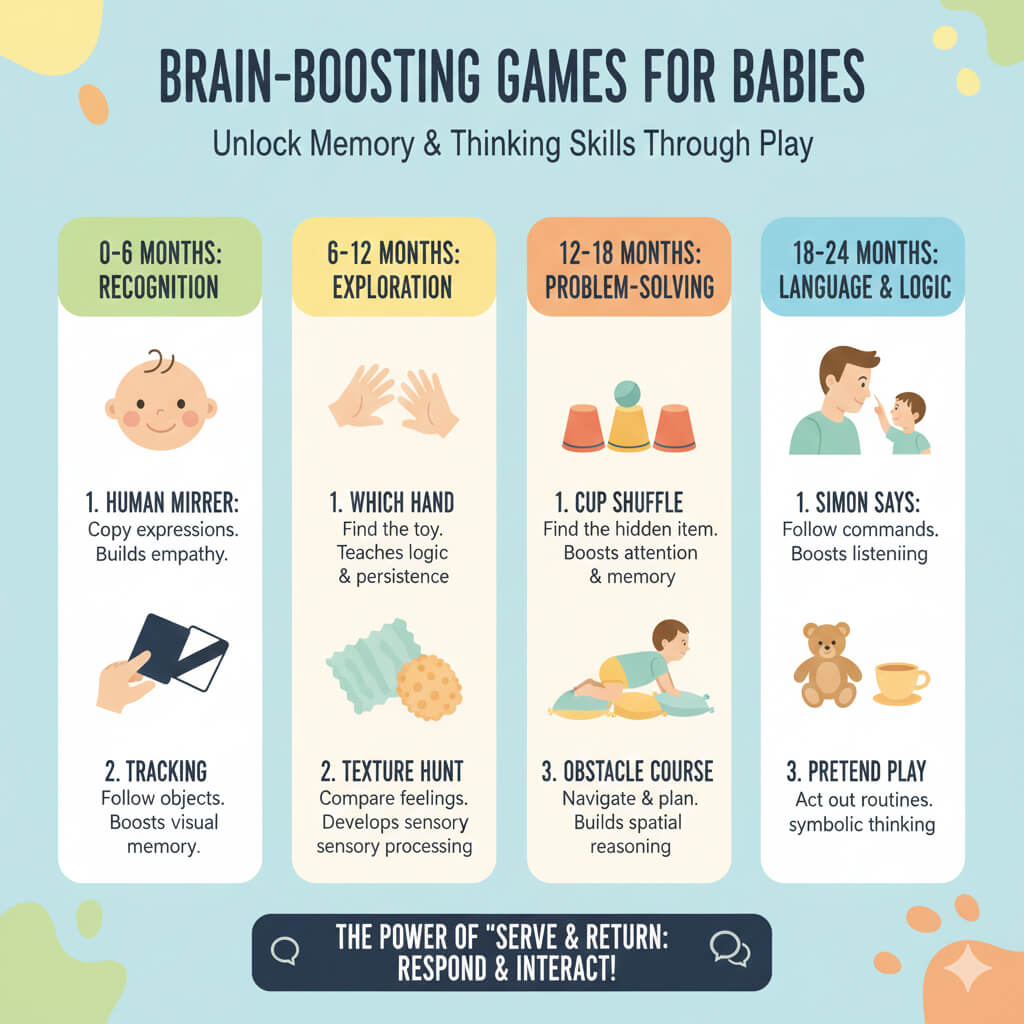
The Human Mirror Game
The Activity: Position yourself about 8–12 inches from your baby’s face. Make a slow, exaggerated expression—like sticking out your tongue or opening your mouth wide. Wait for the baby to process, then see if they attempt to mimic you.
- Brain Boost: This activates mirror neurons, which are essential for empathy and social learning. It also forces the baby to hold an image in their memory (your face) long enough to try to replicate it.
Tracking the “Mystery Object”
The Activity: Use a high-contrast object (a black and white patterned rattle or a bright red scarf). Move it slowly across the baby’s field of vision, then hide it behind your back. Bring it out from the other side.
- Brain Boost: This develops visual tracking and the very early stages of object permanence. It challenges the brain to predict where an object will reappear.
Activities for 5 to 9 Months: The Age of Exploration
As babies gain better head control and begin to sit up, their world expands. They are now moving from passive observers to active participants.
The “Which Hand?” Game
The Activity: Show your baby a small, safe toy. Close both hands into fists, hiding the toy in one. Encourage your baby to reach for a hand. If they choose the empty one, open it to show it’s empty, then show them the toy in the other hand.
- Brain Boost: This is a classic working memory exercise. The baby must remember which hand they saw the toy go into. It also introduces basic probability and logic.
Texture Scavenger Hunt
The Activity: Place three distinct items in front of the baby: something cold (a refrigerated teething ring), something soft (a plush toy), and something crinkly (a piece of clean parchment paper).
- Brain Boost: Sensory input is the “fuel” for brain growth. Comparing different textures requires sensory processing and categorization, a high-level cognitive function where the brain labels and files information.
The Great “Drop and Retrieve”
The Activity: It may be annoying when your baby drops their bottle from the high chair for the twentieth time, but it’s a sign of genius. Join the game. Drop a soft toy, say “Boom!”, and pick it up.
- Brain Boost: This is a live lesson in cause and effect. The baby is testing the laws of gravity and social interaction. “If I do X, then Y happens.” This is the cornerstone of scientific thinking.
Activities for 10 to 15 Months: Logic and Problem Solving
By now, your baby is likely crawling or cruising. Their memory is becoming more robust, and they can follow simple, one-step instructions.
The Three-Cup Shuffle
The Activity: Take three identical opaque plastic cups. Place a favorite snack or toy under one cup while your baby watches. Shuffle the cups slowly and ask, “Where did it go?”
- Brain Boost: This is a significant jump in attention span and visual memory. The baby must track the hidden object through space, ignoring the distraction of the other cups.
The Obstacle Course
The Activity: Use pillows, cardboard boxes, and cushions to create a “tunnel” or a “mountain” on the floor. Place a desirable toy at the end of the course.
- Brain Boost: This develops spatial reasoning. The baby has to plan a route, navigate their body through three-dimensional space, and solve problems (e.g., “How do I get over this pillow without falling?”).
Categorization Baskets
The Activity: Provide two baskets. In one, put all the “soft” things (socks, plushies). In the other, put all the “hard” things (blocks, plastic spoons). Show the baby how to sort them.
- Brain Boost: Categorization is one of the most important cognitive milestones. It allows the human brain to organize vast amounts of data. Even if the baby doesn’t get it “right,” the act of comparing two objects is a massive workout for the prefrontal cortex.
Activities for 16 to 24 Months: Language and Executive Function
Toddlers are beginning to use symbols (words and gestures) to represent things that aren’t there. Their “thinking” brain is coming online in a big way.
The “Simon Says” (Simple Version)
The Activity: Give simple commands like “Touch your nose” or “Hands on head.” Do the action with them at first, then try giving the command without doing the action yourself.
- Brain Boost: This exercises inhibitory control and auditory processing. The child must listen to the word, translate it into an action, and execute that action.
Narrative Play (Storytelling)
The Activity: Use a doll or a stuffed animal to act out a familiar routine, like eating breakfast or going to sleep. Use the toy to “talk” to your toddler.
- Brain Boost: This fosters symbolic thought (understanding that a toy can represent a real person) and sequential memory (remembering the order of daily events).
The Role of “Serve and Return”
Regardless of the game you play, the most important factor in brain development is a concept Harvard University calls “Serve and Return.”
Imagine a tennis match. The baby “serves” by making a sound, a gesture, or a facial expression. You “return” the ball by responding with a smile, a word, or a corresponding action.
- Why it works: When a parent responds reliably to a child’s cues, it strengthens the neural connections that support communication and social skills. Without this interaction, the brain’s architecture does not form as robustly.
Crucial Pillars Supporting Brain Growth
No amount of games can replace the biological basics. For these activities to be effective, the baby’s “hardware” needs to be well-maintained.
1. Sleep: The Memory Consolidator
Research shows that babies who nap after learning a new task are better able to remember it the following day. During sleep, the brain moves information from short-term “temporary” storage into long-term “permanent” storage.
2. Nutrition: The Fuel
The brain uses about 60% of a baby’s total energy. Fats (DHA and ARA), proteins, and iron are the building blocks of the myelin sheath—the insulation around neurons that allows signals to travel faster.
3. Emotional Security
A “stressed” brain cannot learn. When a baby feels safe and loved, their brain releases oxytocin, which promotes social bonding and receptivity to new information. If a baby is in “fight or flight” mode (from being overly tired or hungry), the learning centers of the brain essentially shut down.
Summary Table: Developmental Milestones & Games
| Age | Cognitive Goal | Best Game |
| 0-3 Mo | Pattern Recognition | The Human Mirror |
| 4-7 Mo | Cause and Effect | The Drop-and-Retrieve |
| 8-12 Mo | Object Permanence | The Hidden Toy (Peek-a-boo) |
| 12-18 Mo | Spatial Reasoning | The Pillow Obstacle Course |
| 18-24 Mo | Symbolic Thought | Pretend Play (Tea Party/Phone Call) |
Conclusion
Your baby’s brain is not a vessel to be filled; it is a fire to be lit. You don’t need expensive gadgets or “genius” programs to raise a smart, thoughtful child. You simply need to be present, observant, and playful.
Every time you hide a ball under a blanket, every time you sort socks by color, and every time you wait for your baby to mimic your silly face, you are building a legacy of intelligence. You are teaching them that the world is a logical, predictable, and fascinating place worth exploring.
The goal isn’t to create a “super-baby.” The goal is to give your child a sturdy foundation—a brain that is flexible, resilient, and endlessly curious.
Tips for Success
- Follow the Lead: If your baby is bored with the cup game but wants to stare at the shadows on the wall, follow the shadows. Their brain knows what it needs to study.
- Narrate Everything: “I am picking up the blue cup. It feels smooth.” Language is the bridge to complex thought.
- Keep it Short: A baby’s “study session” usually lasts about 5 to 10 minutes. When they turn away or get fussy, the “class” is over!