
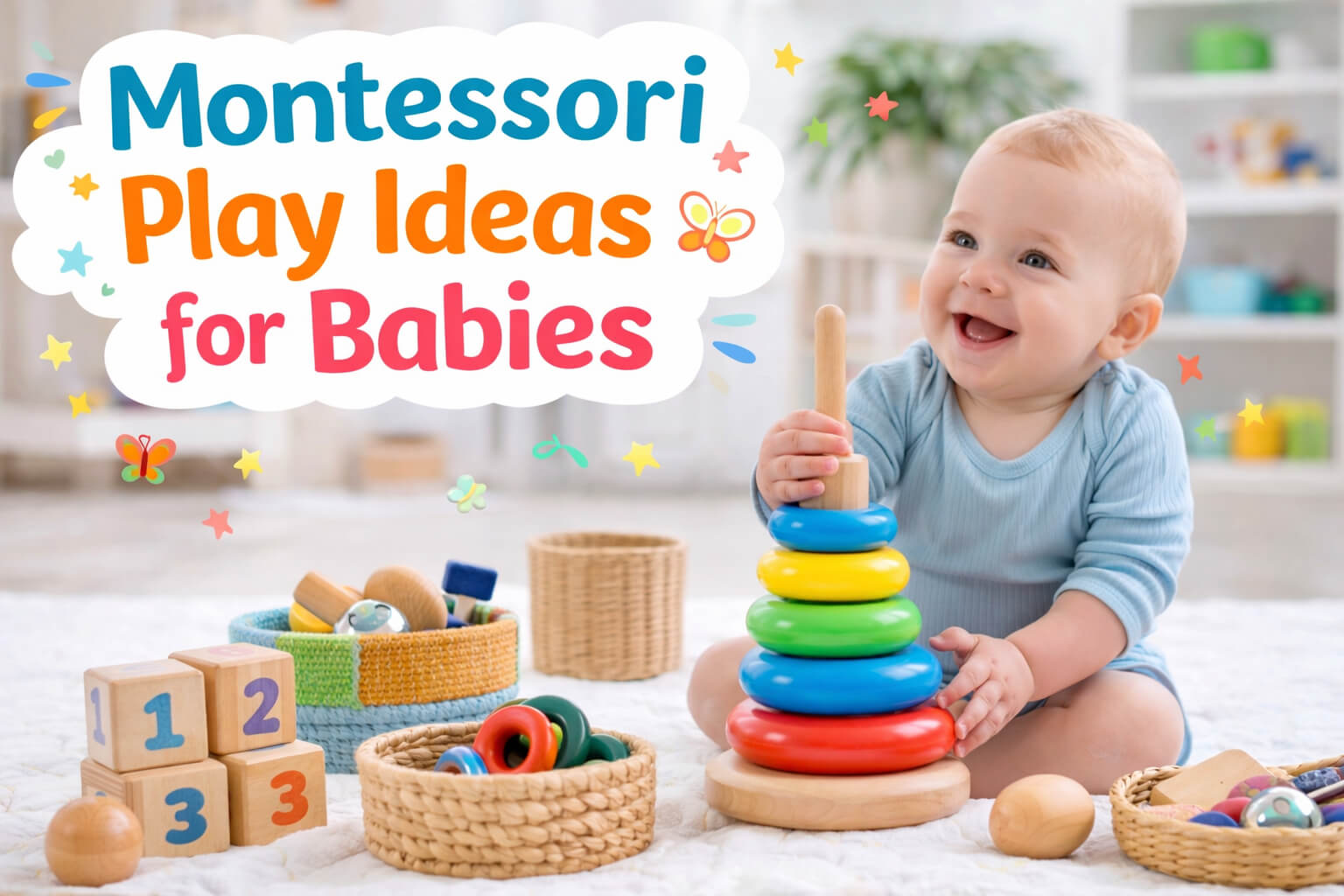
Babies are natural learners. From the moment they are born, they observe, explore, and absorb information from the world around them. The Montessori approach to play respects this natural curiosity by encouraging independence, hands-on learning, and development at a child’s own pace.
Many parents think Montessori play requires expensive wooden toys or a special setup—but that’s not true. Montessori play for babies can be simple, affordable, and easy to do at home, using everyday objects and intentional activities.
In this guide, you’ll learn what Montessori play really is, why it’s beneficial for babies, and age-appropriate Montessori play ideas that support physical, cognitive, and emotional development.
What Is Montessori Play?
Montessori play is based on the educational philosophy developed by Dr. Maria Montessori. For babies, it focuses on:
- Child-led exploration
- Real-life experiences
- Hands-on, sensory-rich activities
- Freedom within safe limits
- Respect for the child’s pace
Instead of overstimulating toys with flashing lights and loud sounds, Montessori play uses simple materials that encourage babies to think, move, and explore independently.
Why Montessori Play Is Beneficial for Babies
1. Encourages Independence
Babies are trusted to explore freely, which builds confidence and self-motivation.
2. Supports Natural Development
Activities are matched to developmental stages rather than age labels.
3. Improves Focus and Concentration
Simple toys help babies stay engaged longer without overstimulation.
4. Strengthens Motor Skills
Montessori play encourages grasping, reaching, rolling, crawling, and coordination.
5. Builds Problem-Solving Skills
Babies learn through trial and error rather than adult direction.
Key Montessori Principles for Baby Play
Before jumping into activities, it’s helpful to understand a few core Montessori principles:
- Follow the child: Observe your baby’s interests
- Less is more: Fewer toys lead to deeper engagement
- Real objects over plastic: Wood, metal, fabric, and glass (when safe)
- Freedom of movement: Allow babies to move naturally
- Order and routine: Predictable environments help babies feel secure
How to Create a Montessori-Friendly Play Space
You don’t need a separate room. A small, safe area is enough.
Montessori Play Space Essentials:
- Soft floor mat or rug
- Low shelf or basket with 4–6 toys
- Baby-safe mirror
- Natural light
- Minimal clutter
Rotate toys weekly to keep your baby interested and focused.
Montessori Play Ideas by Age
Montessori Play for Newborns (0–3 Months)
At this stage, babies are learning to use their senses and control basic movements.
1. Visual Tracking with High-Contrast Cards
Place black-and-white cards near your baby during awake time.
Benefits:
- Visual development
- Focus and attention
2. Montessori Mobile Observation
Hang a simple mobile above your baby’s movement area.
Benefits:
- Eye coordination
- Concentration
- Calm observation
3. Floor Movement Time
Allow your baby to lie freely on a mat without restrictions.
Benefits:
- Natural movement
- Muscle development
Montessori Play for 3–6 Months
Babies begin reaching, grasping, and exploring objects.
4. Grasping Basket
Fill a small basket with safe items:
- Wooden ring
- Fabric ball
- Silicone teether
Benefits:
- Hand-eye coordination
- Fine motor skills
5. Mirror Play
Place a baby-safe mirror at floor level.
Benefits:
- Self-awareness
- Visual tracking
- Emotional development
6. Tummy Time Exploration
Place one simple object in front of your baby during tummy time.
Benefits:
- Neck and core strength
- Motivation to lift head
Montessori Play for 6–9 Months
Babies start sitting, rolling, and crawling.
7. Object Permanence Play
Use a cloth to gently cover and reveal a toy.
Benefits:
- Memory development
- Understanding cause and effect
8. Treasure Basket
Fill a basket with safe household items:
- Wooden spoon
- Metal cup
- Soft brush
- Fabric scraps
Benefits:
- Sensory exploration
- Curiosity
- Independent play
9. Rolling Ball Activity
Roll a ball slowly toward your baby.
Benefits:
- Gross motor skills
- Coordination
- Social interaction
Montessori Play for 9–12 Months
Babies love exploring how things work.
10. Container Play
Offer containers with lids or openings.
Benefits:
- Problem-solving
- Fine motor control
11. Pull-and-Push Objects
Simple pull toys or pushing a box.
Benefits:
- Walking preparation
- Balance and strength
12. Cause-and-Effect Toys
Toys where actions lead to results (pressing, dropping).
Benefits:
- Logical thinking
- Confidence
Montessori Play for 12–18 Months
Toddlers become more independent and curious.
13. Practical Life Activities
Let your toddler:
- Put toys in a basket
- Stack cups
- Carry small items
Benefits:
- Independence
- Coordination
- Responsibility
14. Posting Activities
Drop coins or shapes into a slot.
Benefits:
- Fine motor skills
- Concentration
15. Simple Puzzles
Large knob puzzles with basic shapes.
Benefits:
- Problem-solving
- Hand strength
Montessori Toys vs Traditional Toys
| Montessori Toys | Traditional Toys |
|---|---|
| Simple design | Flashy & noisy |
| Encourage thinking | Often entertain passively |
| Natural materials | Mostly plastic |
| Open-ended play | Fixed outcomes |
Both types can coexist, but Montessori toys encourage deeper learning.
Everyday Household Montessori Play Ideas
You don’t need to buy new toys.
Safe household items include:
- Measuring cups
- Scarves
- Empty boxes
- Wooden spoons
- Fabric scraps
Supervised play with real objects builds real-world skills.
Toy Rotation: A Montessori Essential
Instead of offering many toys at once:
- Display 4–6 toys
- Rotate weekly
- Observe what interests your baby
This keeps playtime engaging and reduces overwhelm.
Common Montessori Play Mistakes to Avoid
- Over-directing your baby
- Interrupting focused play
- Offering too many toys
- Choosing toys that are too advanced
- Expecting quick results
Montessori play is about patience and observation.
How Parents Support Montessori Play
Your role is not to entertain—but to guide.
- Observe quietly
- Demonstrate slowly
- Use minimal words
- Encourage effort, not perfection
- Respect your baby’s pace
Is Montessori Play Safe for Babies?
Yes, when done correctly:
- Always supervise
- Choose age-appropriate materials
- Avoid choking hazards
- Keep play areas clutter-free
Safety and freedom go hand in hand.
Final Thoughts: Montessori Play Is About Simplicity
Montessori play doesn’t require perfection, expensive toys, or strict rules. It’s about respecting your baby as a capable learner and creating an environment where exploration feels natural and joyful.
By offering simple, purposeful play experiences, you’re helping your baby develop:
- Confidence
- Focus
- Independence
- Strong physical and cognitive skills
Sometimes, the simplest play ideas make the biggest impact.